
“There’s dancing, behind movie scenes
Behind the movie scenes- Sadi Rani
She’s the one that keeps the dream alive
From the morning, past the evening
To the end of the light
Brimful of Asha on the 45”.
‘Brimful of Asha’ is a song by English band Cornershop released in 1997. The lyrics are a tribute to Asha Bhosle.
Asha Bhosle – a Guinness world record holder, a recipient of the Padma Vibhushan and the Dadasaheb Phalke Award – has held us spellbound for 7 decades now. She turns 92 today. Her voice has imbued life into a range of genres – from the melancholic melody to the spirited rock ‘n’ roll; from the soulful song to the energetic disco; from the romantic rhapsody to the lively folk song; from the gentle ghazal to the rambunctious qawwali; and from the poignant rendition to the spicy sensuous number.
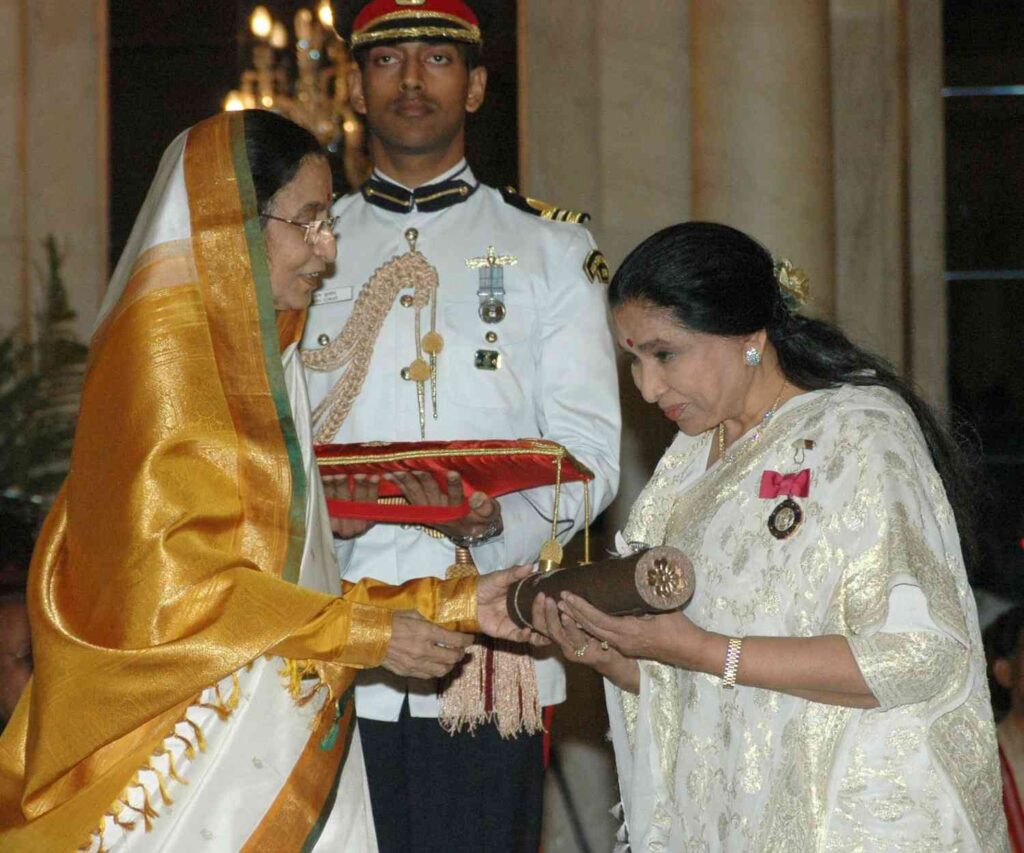
No one has been immune from her jaadu. As she very rightly put it in Lootmaar (1980)- “Jab chhaye mera jaadu, koi bach na paaye”.
Against odds that would have driven any other woman into quitting, she has reached the summit of her profession. Asha is no quitter She is indeed unique with an unrivalled musicality and a piquant image. She has faced the slings and arrows of outrageous fortune with success. It wasn’t always easy for the singer whose voice has emoted every mood for actors down generations, right from Madhubala to Kajol and scores of others in between.
For Asha, music is like breathing. “Humari saans nahin hoti hai toh aadmi mar jata hai. Mere liye music meri saans hai. I have spent my life with this thought. I have given a lot to music. I feel good I’ve come out of difficult times. Many times, I felt I would not be able to survive, but I did,” she says.
“In every field, there’s politics. In films, too, there’s politics, so it is not easy. I believe a lot in destiny and I believe whatever is meant for me will come to me and what is not meant for me, I’ll never get that. I faced difficulties but today when I look back, it all looks mazedar as I came out of it,” she says.
As the third child of Master Deenanath Mangeshkar, Asha grew up with music, although she did not receive much formal training from her father. She was eight when her father passed away with eldest sister Lata carrying the burden of providing for the family. Asha sang her first film song ‘Chala Chala Nav Bala’ for the Marathi film Majha Bal (1943). She made her Hindi film debut with ‘Saawan Aaya’ for Chunariya (1948). Her first solo Hindi film song was for the movie Raat Ki Raani (1949).
When Asha was around 15, she eloped with her neighbour, Ganpatrao Bhosle, a ration inspector, against the wishes of her family. Thus began her first troublesome chapter of life. “Once Asha was married, her husband did not want her to have anything to do with us,” said Lata Mangeshkar in Lata Mangeshkar… In Her Own Voice, a book by Nasreen Munni Kabir. “She wasn’t allowed to see us or write to us. This was the situation for years. Ganpatrao Bhosle used to take Asha to various music directors and make her audition for them. He believed that she would earn him lots of money and wanted to control her. Asha suffered a lot during those years.”
Traumatised, Asha left her husband in 1960. A single parent with three kids and a failed marriage, Asha was, by then, already a well-known playback singer.
However, earlier it was different. In the early 1950s, Geeta Dutt, Shamshad Begum, and Lata dominated the singing for the female lead and the big films. Asha used to get the assignments they didn’t want to touch, singing for the vamps, or songs in low-budget movies.
She would take any assignment that came her way and in doing so, developed a formidable reputation for versatility. Versatility is Asha’s middle name. She says – “I’ve sung songs for the main artist and for the dancers as well. I believe I could fit in well with anyone. But I wish I had sung more songs in different languages. I wish I could have done more classical singing.”
Regarding classical singing, she collaborated with sarod maestro Ustad Ali Akbar Khan in the album Legacy featuring 16th -18th century music of India (Guru Bandana, Hori, Tarana, Kheyal, Dhrupad, Sadra). The album received Grammy nomination in 1997. Listening to this masterpiece is a sublime experience.
In 1957 she had her first big break when she lent her voice to the leading lady Vyjayanthimala in Naya Daur (1957), which was a runaway success, and Asha would never look back. OP Nayyar was the music director. Earlier, she had sung for him in a few films. However, it was the success of Naya Daur that made the duo very popular. Asha’s story has OP Nayyar playing a vital role in her life, professionally and personally. The song in the said movie summed it up – “Maang ke saath tumhara, maine maang liya sansar”.
OP Nayyar’s association – both professional and personal with Asha is part of Hindi film lore. Their love affair lasted several years. For Asha, love was in the air again.
OP Nayyar was the composer who first gave Asha her own identity, her self-confidence, made her realise her self-worth, smoothened her rough edges, trained her, removed her from out of the shadow of her sister. She became his muse and recorded some of her biggest triumphs under his nurturing.
The team of OP Nayyar and Asha is best remembered for their breezy, romantic, sensuous, and coquettish songs. For example, the two songs from Mere Sanam (1965) – ‘Jaaiye Aap Kahan Jaayenge’, and ‘Yeh Reshmi Zulfon Ka Andhera’.
Of course, there were serious songs as well, such as, for example ‘Main Shayad Tumhare Liye Ajnabee ‘from Yeh Raat Phir Na Aayegi (1966).
OP Nayyar used the Asha-Mohammad Rafi duo for his most popular duets such as, say, ‘Isharon Isharon Mein Dil Lenewale’ from Kashmir Ki Kali (1964). Because Lata was not in the picture and Geeta Dutt had been shown the door, it was natural for Asha to step in.
I was friends with OP Nayyar when I was posted in Mumbai, and continued to be his friend till his death. I would meet him often and discuss his life in the film industry. I asked him about Lata. Contrary to popular belief, OP Nayyar said he had no fight with Lata. “So why didn’t you take her for a single song,” I quizzed him. “Her voice wouldn’t have suited any of my songs. Can you think of any?”
OP Nayyar’s musical style called for robust, deep-voiced female singers. Asha (and Geeta Dutt, Shamshad Begum) fitted the bill; Lata, with her thin and thread-like voice, didn’t.
The spectrum of Asha’s singing is boundless and because of this, she could sing all sorts of songs. Asha’s voice is tailor-made for songs that have a light coquettish streak, which require oomph. She could also, with equal finesse, sing poignant songs.
OP Nayyar’s music had a robustness and a rhythm which set him apart from the other composers. His songs were bewitching, easy on the ears. The songs were playful and naughty, seductive and sensuous. Some of them were also sad.
And, therefore, he thought Asha was the best fit, just like Geeta had been earlier.
OP Nayyar also told me that whenever Asha’s songs are discussed, only two composers are mentioned, who made her a complete singer – OP Nayyar and RD Burman.
However, SD Burman’s contribution is never acknowledged. There was a misunderstanding between SD Burman and Lata, and Asha stepped into SD Burman’s studios from 1957 to 1962. Once she entered his studios, even though she was not his number one choice, he groomed her, honed her skills and exploited the entire gamut of her singing range – the breezy, the mischievous, the pathos, the romantic. He, along with OP Nayyar and RD Burman, was also responsible for making her a complete singer. Consider some of the songs-
‘Kali Ghata Chhaye Mora Jiya Tadpaye’ from Sujata (1959), ‘Koi Aaya Dhadkan Kehti Hai’ from Lajwanti (1958) and ‘Nazar Lagi Raja Tore Bangle Par’ from Kala Pani (1958).
After SD Burman patched up with Lata, she again became his singer of first choice. Yet he continued to take Asha in certain songs where only she could do justice, like ‘Ab Ke Baras Bhej’ from Bandini (1963)and ‘Raat Akeli Hai’ from Jewel Thief (1967).
Asha recorded her last song for OP Nayyar in the movie Pran Jaaye Par Vachan Na Jaaye (1974). The song ‘Chain Se Humko Kabhi’ garnered the Filmfare Award, but it was not included in the movie.
They separated in 1972. The parting was bitter, and therefore she doesn’t give OP Nayyar his due. Asha released Rahul & I (remixed by Leslie Lewis) in 1996, never OP & I. While talking about OP Nayyar in an interview, she once remarked, “Whichever composer gave me work, it was because my voice was suited to his music at that point. No one musician did me any favour by asking me to sing for him.” She gives the credit for her first big break to Producer- Director BR Chopra for Naya Daur. A long professional and personal association came to an end.
And what did OP Nayyar have to say about the parting? His bitterness about Asha would surface now and then -how she only gave credit to RD Burman, and not to him, in making her what she finally became. On being asked the reason for their parting, OP Nayyar said, “I know astrology very well. I knew that one day I had to part with her. Something also happened that upset me, so I left her.” Nevertheless, he also said, “I can say that the most important person in my life was Asha Bhosle. She was the best person I ever met.”
Her next phase was with RD Burman. In 1966, Asha’s performance in RD Burman’s Teesri Manzil, won popular acclaim. Reportedly, when she first heard the dance number ‘Aaja Aaja’, she felt she would not be able to sing this westernised tune. While RD Burman offered to change the music, she refused, taking it as a challenge. She completed the song after ten days of rehearsals, and ‘Aaja Aaja’, along with such other songs as ‘O Haseena Zulfonwali’ and ‘O Mere Sona Re’ became successful. Shammi Kapoor, the film’s leading actor, was once quoted as saying– “If I did not have Mohammad Rafi to sing for me, I would have got Asha Bhosle to do the job”. Asha’s collaboration with RD Burman resulted in numerous hits and a marriage in 1980. Their partnership lasted until his death.
She recorded a variety of songs with him – cabarets, rock, disco, ghazals and classical.
In the 1970s, Asha and RD Burman’s youthful Westernised songs took Hindi film music by storm –the rebellious ‘Dum Maro Dum’ from Hare Rama Hare Krishna (1971), the sexy ‘Duniya Mein’ from Apna Desh (1972), the romantic ‘Chura Liyaa Hai Tumne’ from Yaadon Ki Baaraat (1973) and the raunchy cabaret ‘Piya Tu Ab to Aaja’ from Caravan (1971).
RD Burman also recorded many hit duets with Asha and Kishore Kumar such as ‘Jaane Jaan’ from Jawani Diwani (1972) and ‘Bhali Bhali Si Ek Soorat’ from Buddha Mil Gaya (1971).
During one evening, OP mentioned to me that he had great respect for RD Burman’s talent and viewed him as a kindred spirit. Both were trend-setters; both defied the existing musical mores; both used musical instruments innovatively; both were rhythm masters. And both had Asha as their muse!
Then came the shocker from him – he claimed that irrespective of Asha being firmly ensconced in RD Burman’s studio and heart, RD Burman gave his best songs to Lata!
It has been a general rule with RD Burman, with exceptions of course, that melodious and semi-classical songs went to Lata; the frothy, fun-filled, rhythm-oriented ones to Asha.
Of course, Asha did melody-based songs too – songs of Ijaazat (1987) for example, ‘Mera Kuchh Saamaan’, ‘Khaali Haath Shaam Aayi Hai’ and ‘Katra Katra’, but these were glorious exceptions. OP Nayyar was of the view that when posterity tabulates the “best” of any music director, it is believed that the melody-based tunes ordinarily trump the other category.
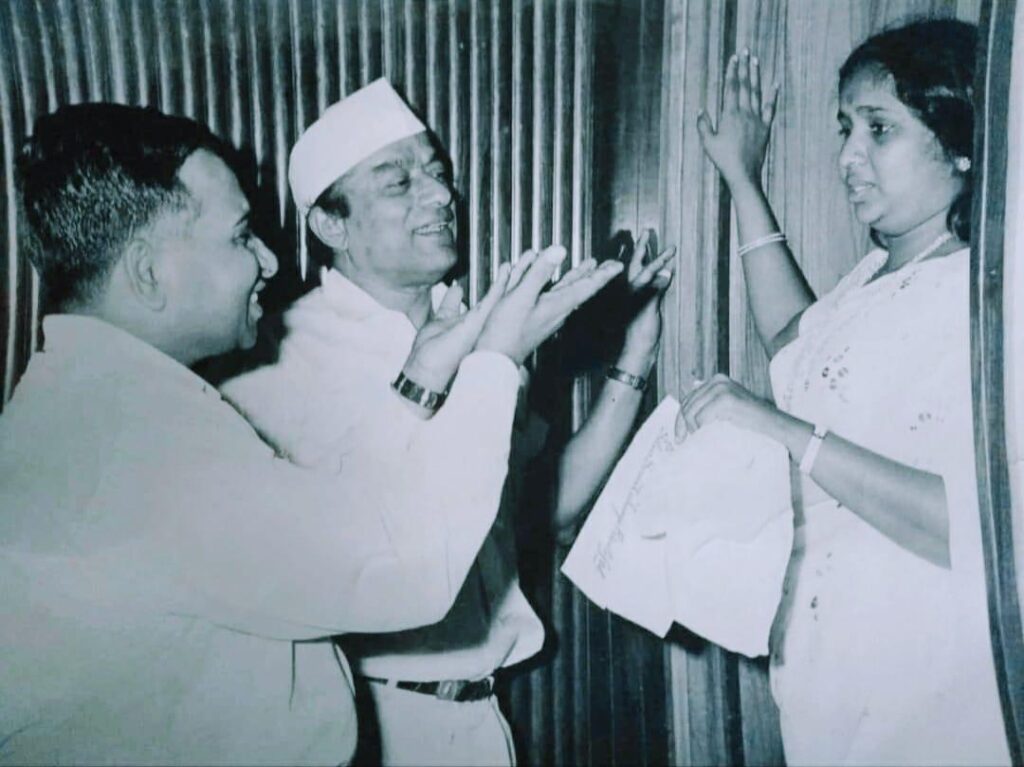
My uncle, late Satish Bhatia, who retired as Chief Producer (Light Music), All India Radio, knew Asha very well. She had sung 3 songs for him in V Shantaram’s Boond Jo Ban Gayi Moti.
Another music director who recognized Asha’s talent early was Khayyam. Their partnership dates back to his first movie Biwi (1948). Khayyam gave her some good assignments in the 1950s, including Phir Subah Hogi (1958).
However, their collaboration is chiefly remembered for the songs of Umrao Jaan (1981). I knew Khayaam and asked him the secret of Asha Bhosle sounding so different in Umrao Jaan. That’s because I made her sing in a lower octave than her usual scale, he explained. She asked for a week to prepare. On the day of the recording, she got cold feet and asked if she could sing in her own scale. They agreed that they would record in both scales, and she could then select.
Later, when she heard the recording in the lower octave, she was ecstatic and said she didn’t know she could sing like that. The songs were a rage and fetched Asha her first National Film Award for best female singer.
Music composer Ravi considered Asha one of his favourite singers. She sang for his first movie Vachan (1955). The melodious lullaby from this movie, ‘Chanda Mama Door Ke’ became an overnight hit among young mothers in India. Ravi got her to sing bhajans for the movies Gharana (1961), Grihasti (1963), Kaajal (1965) and Phool aur Patthar (1966). Ravi and Asha recorded a variety of songs, including the popular comic duet with Kishore Kumar – ‘C A T…Cat. Cat Maane Billi’ and ‘Yeh Ratein Yeh Mausam’ from Dilli ka Thug (1958).
They also recorded songs for many popular movies like Gumrah (1963) and Waqt (1965)
When Jaidev started giving music independently, he got Asha to sing some of his songs as well. They worked in Hum Dono (1961)- ‘Abhi Na Jao Chhod Kar’, Mujhe Jeene Do (1963), Do Boond Pani (1971) and other movies. In 1971, the pair released an LP of eight non-film devotional songs and ghazals called An Unforgettable Treat. Asha considered Jaidev a close friend who stood by her when she was struggling personally and professionally. Upon his death in 1987, she released a compilation album of lesser-known songs he had composed for her, called Suranjali.
Madan Mohan, though firmly in Lata’s corner, recorded a number of songs with Asha, including the popular ‘Jhumka Gira Re’ from Mera Saaya (1966), and ‘Shokh Nazar Ki Bijliyan’ from Woh Kaun Thi (1964).
Hemant Kumar, again in Lata’s corner, gave Asha some delightful songs such as ‘Bhanwara Bada Naadaan Hai’ from Sahib, Biwi aur Ghulam (1962).
Bhappi Lahri, the disco king, composed some outstanding songs for Asha. Both Kishore Kumar and Asha were his staple during the Madras days of Jeetendra / Sridevi /Jayaprada. He also composed hit music for Prakash Mehra such as ‘Raat Baaqi Baat Baaqi’from Namak Halal (1982).
And so, the decades flew by – some very busy, some not so. AR Rehman is credited with Asha’s comeback with Rangeela (1994). Songs like ‘Tanha Tanha’ and ‘Rangeela Re’ were chartbusters. She and Rahman went on to record more hits like ‘Mujhe Rang De’ from Thakshak (1999) and ‘Radha Kaise Na Jale’ from Lagaan (2001).
Let’s now address the issue of Asha’s sibling rivalry with Lata, in spite of their insistence that these are just tales. As young children, they were very close. Lata used to carry Asha all the time. They were so inseparable that when Lata went to school, she would take Asha with her. One day the teacher protested and said that they could not have two students on one fee. Lata refused to return to school without Asha and quit her studies.
Lata considered Asha’s act of eloping as irresponsible, leaving her alone to sing and earn for the family. This led to tensions between them. Asha herself stated in an interview – “It was a love marriage and Lata didi did not speak to me for a long time. She disapproved of the alliance.”
In her initial days, Asha always played second fiddle to her elder sister. Some say that Lata had once criticised Asha’s relationship with OP Nayyar. This widened the rift between the two sisters. OP Nayyar had once revealed that “Asha and Lata, staying in opposite flats at Bombay’s Peddar Road, shared a maid. The maid would tell the younger sister that Lata had just recorded something wonderful for Asha to lose her vocal poise. Such was her Lata phobia that it took me some months to convince Asha that she had a voice individualistic enough to evolve a singing style all of her own.” Asha once said that she has worked for years to create a voice and a style that was different from Lata, so that she could carve her own niche and not be banished to live in her sister’s shadow.
The movie Saaz (1997) was supposedly based on Lata and Asha’s rivalry. Asha said about the movie – “To have two women in long plaits, take a couple of incidents and exaggerate them into a 3-hour film is such a waste of time.”
Towards the end, Asha and Lata were often seen in public, enjoying each other’s company. In an interview, Asha once said – “I remember, sometimes both of us would be at a function and some industry types would ignore me and interact only with her, as if to prove their loyalty. Later, didi and I would have a good laugh!” The sisters were once again close.
Asha and Lata have sung songs together. Asha’s duets with Lata are delightful to hear. Asha once compared the experience of recording with Lata to a festive occasion, where there was eager anticipation of sweetmeats. All that it took to inspire Asha was a joyful smile from Lata in appreciation of a musical passage while they were singing on the microphone. Some of their songs include ‘O Chand Jahaan Woh Jayein” from Sharada (1957), ‘Mere Mehboob Mein Kya Nahi’ from Mere Mehboob (1963), ‘Main Chali Main Chali’ from Padosan (1968), and ‘Man Kyun Behka’ from Utsav (1984).
Asha has had flourishing non-film music projects – collaboration with Ghulam Ali in the album Meraj e Ghazal (1983). Asha holds her own against the ghazal maestro. She collaborated with Gulzar and RD Burman in Dil Padosi Hai (1987). In 2006, Asha released Love Supreme which inter alia was an ode to ghazals of stalwarts like Mehdi Hasan, Ghulam Ali, Jagjit Singh, sung by her, in a modern, accessible to the younger generation style.
Asha released her debut album as a composer Aap Ki Asha in 2001 which was a tribute to Majrooh Sultanpuri. I attended the launch by the Music Company and met Asha. She was very friendly and down to earth.
Asha has collaborated with several prominent British artists, including Boy George for the song ‘Bow Down Mister’ (1991) and the British band The Kronos Quartet on their album You’ve Stolen My Heart (2005). She also performed with the pop group Code Red on the song ‘We Can Make It’ (1997) and has been featured alongside other singers like Sunidhi Chauhan and Sharon Prabhakar in projects such as ‘Will to Live’ (2011). She collaborated with Australian cricketer Brett Lee in ‘Haan Main Tumhara Hoon’ in Asha & Friends (2006) in which Brett plays a Westerner trying to woo a young Indian woman.
Asha has faced huge personal tragedies. The eldest of her three children, Hemant Bhosle died of cancer in 2015. Her daughter Varsha committed suicide in 2012; she was 56 years old and worked as a columnist. Asha’s youngest child, Anand Bhosle manages Asha’s career. Her grandson, Chaitanya Bhosle (Hemant’s son) is a member of India’s first and only boy band, A Band of Boys. Her granddaughter Zanai Bhosle (daughter of Anand Bhosle) is an emerging singer and Kathak dancer and has sung with Asha Bhosle.
In 2013, Asha debuted in the film Mai in the title role, at the age of 79. Asha played the role of a 65-year-old mother who suffers from Alzheimer’s disease and is abandoned by her children. She received positive reviews for her acting.
Asha is an excellent cook and cooking is her favourite hobby. Once, when asked in an interview, what if her singing career had not taken off, she said- “I would have become a cook.” The love of cooking got Asha into a successful restaurant business in the Middle East and the UK. She takes care of the kitchen and the décor. She personally trains the chefs.
I have visited the restaurant in Dubai and it’s amazing.
Let’s now address the elephant in the room – who is the better singer of the two sisters. Of course, comparisons are odious.
When Naushad was asked to sum up the essential difference between Lata and Asha, he said that Asha “lacks certain something which Lata, and Lata alone has.” Later he stated in an interview, “Maybe I said it because I then had a closed ear on Asha”. Naushad, later in his life, also admitted that he has been unfair to Asha.
RD Burman himself admitted that Lata was a better singer. In The Times of India, Bombay, September 29, 1985, he said, “…there is no doubt that Lata-ji is supreme. When she sings, she forgets about herself, her home, and there’s a complete changeover of personality. Though she may not admit this, she becomes a mother, or a sweetheart before the microphone.”
Their singing styles are different as are their personalities. Their personalities shape their music. Asha befriends anyone easily. She can break into a hearty guffaw. Latawas the opposite. She was careful about her public image. Their singing is an extension of who and what they are.
Lata enjoys a goddess-like status. She was pious and you could not ever touch her. Asha is human. That’s why people point out flaws in her, that’s why critics get away saying that she can only do racy numbers. She is prone to scrutiny as much as any other artiste. She doesn’t take herself seriously, maybe that’s why she is taken for granted at times. She gives off vibes that she is one of us, not above criticism.
One fundamental difference between the sisters is that while Lata has rarely taken risks with songs or their rendering, Asha has experimented.
So that still begs the question – who is better?
In my opinion, their different styles means that they can’t be compared; that they can’t run the same race? The Govt may have given Lata the top most award, and Asha the second highest. Of course, that may change in the coming years – and it should. Both deserve to be at the top of the podium – standing side by side.
Asha is a courageous woman, a fiercely independent person and had often had to pay a price for that. Success has come to her at a cost and she values it. She likes to keep the mood light. Laughter and happiness is her way of dealing with tragedies. She is an optimist. She is asha.
The song composed by Ustad Vilayat Khan, sums up her life story aptly:
“Ambar ki ek paak suraahi, baadal ka ek jaam uthaakar
Ghoont chaandni pee hai humne, baat kufr ki ki hai humne!”
Kadambari (1976)
The Last Moghul turns 92 today, with no signs of slowing down. She can stand for three hours on stage and sing songs and is happy doing it at this age. She says that music, like an ever-flowing river, never ends; she could well be describing her own career. What started in 1943, continues to this day, 12,000 songs later. Even after a lifetime of performing she does rehearsals before concerts. Before going on stage, she feels very nervous and then the moment she’s on stage she forgets everything just by looking at the love of the audience.
Singer. Mother. Grandmother. Fighter. Survivor. Asha Bhosle is all that rolled into one.
As the famous song of Frank Sinatra goes –
“I have lived a life that is full
I have travelled each and every highway
And more, much more than this
I did it my way. “
Thank you, Asha.
(Cover Photo: Asha Bhosle Performing at Vienna. Photo credit: Bryan Murphy, Wolf Trap)
Asha BhosleBollywoodDadasaheb Phalke AwardLegendary SingerPadma VibhushanSinger