
If her music was ethereal, Girija Devi’s personality was equally captivating. I first met her in 2001 at her bungalow in Varanasi. She greeted me with a warm smile, snow-white hair, mischievously twinkling eyes, a diamond nose pin, and paan-stained teeth. Draped in a beautiful Banarasi saree, she was resplendent, radiating the warmth and charm that made her so beloved.
Her house was bustling with young girls—her students, who lived with her in the traditional guru-shishya parampara. They were a part of her extended family, sharing meals, helping with everyday household chores, and absorbing the nuances of music through the experience of living with their guru. The girls presented a brief musical recital, with Girija Devi gently guiding and overseeing the proceedings.
Later, over cups of tea and plates of kachoris, we talked about her life and music. For all her formidable talent and stature, she was remarkably self-effacing, warm, and grounded. Her infectious laughter punctuated our conversation, putting me instantly at ease. There was nothing intimidating about her presence; instead, she possessed the rare ability to make one feel completely at home.
One of the things that fascinated me most was her collection of dolls, a passion that had begun in childhood and remained with her throughout her life. Whenever she learnt and mastered a new song, her father would reward her with a doll. Thus began a collection that grew alongside her musical journey. Years later, as an internationally acclaimed artist travelling across continents, she continued to add to it, bringing home a doll from every city where she performed. It was touching to see how, despite the passage of time and the heights of her musical achievement, the little girl’s delight in collecting dolls remained undiminished.
During our conversation, she told me that she had been seeking land for a music academy for several decades, but her efforts had yet to bear fruit. It was a poignant reminder that even an artist of her stature continued to nurture a dream for the future of music and the generations who would inherit its traditions.
Before I left, I requested her to sing a thumri for me. She graciously obliged, and what followed was a brief but unforgettable private concert. She held nothing back. Her voice was as magical, powerful, and resonant as one might expect from a maestro of her stature—full-throated, rich, and deeply expressive. Without the grandeur of a concert hall or the presence of an audience, I experienced her music in its most intimate form: direct, unadorned, and profoundly moving.
That encounter lasted only a short while, but its memory has endured. Even today, I can recall the deep, melodious voice of Girija Devi singing just for me that day. Fondly known as Appa-ji, she was not merely a great musician but a warm, generous human being whose music and personality were inseparable.
In the winding, ancient lanes of Banaras, where spirituality and everyday life have intertwined for centuries, emerged a voice that captured the essence of the city. It possessed the rare ability to express the playful charm of love, the deep anguish of separation, and the profound ecstasy of devotion. This was the voice of Girija Devi, one of the most distinguished exponents of Hindustani classical music.
More than a celebrated vocalist, she was a guardian of tradition, preserving and enriching the musical and cultural heritage of Banaras for generations to come. Her music carried within it the sounds, stories, dialects, and emotions of a region whose artistic traditions had evolved over centuries. Through her extraordinary command of melody and poetry, she gave these traditions a wider audience without diminishing their distinctive character.
Her musical education extended far beyond formal training; it was deeply rooted in the cultural and spiritual milieu of Banaras. In many ways, the city itself became her greatest teacher. The resonant strains of the shehnai drifting from temple courtyards, the rhythmic chants of priests along the banks of the Ganga, the soulful songs of boatmen, and the seasonal folk traditions of kajri, chaiti, and hori gradually shaped her musical sensibility.
Immersed in this vibrant soundscape, she developed a style distinguished by its emotional depth, earthy richness, and evocative charm—one that reflected the cultural vitality and folk traditions of the Purvanchal region.
She embodied the Purab Ang of thumri with such mastery that the tradition seemed to find one of its fullest expressions in her voice. Khayal, thumri, dadra, kajri, chaiti, holi, tappa, and the rich hues of folk music flowed through her singing, not as relics of a bygone age but as living expressions of human experience. In her voice, they breathed and blossomed, flirted and teased, ached and grieved, carrying within them the memories, moods, and rhythms of a world that refused to fade.
She had mastered the nuances of thumri—its grammar, emotional depth, and lyrical beauty—weaving them into a delicate tapestry of moods and emotions each time she took the stage. Much of the credit for bringing thumri to a wider concert audience belongs to her, who helped reshape its public reception and carry it beyond the intimate settings of courts and kothas to the modern concert stage, while preserving its exquisite emotional richness.
Born in 1929, Girija Devi was the first musician in her family to pursue music professionally. Her father, Ramdev Rai, was a landlord who lived in a village but possessed a deep passion for music. He would often travel to Banaras to listen to renowned musicians and was himself learning the art. Recognising his young daughter’s natural inclination towards music, he frequently took her along on these visits.
Soon, it became apparent that Girija possessed an exceptional musical sensitivity. Her father arranged for her formal training and even took accommodation in Banaras to ensure that her education could continue without hindrance. Ahead of his time, he encouraged her not only to sing but also to develop a wide range of skills, including archery, swimming, and horse riding.
At a time when women performing publicly often faced social disapproval, her father’s progressive outlook proved decisive. He brought her up with the confidence and independence he might have encouraged in a son, teaching her to be fearless and self-reliant. Although Girija showed little inclination towards formal academic studies, he ensured that she received instruction in Hindi, Urdu, and English.
At the age of five, she began her musical training under Pandit Sarju Prasad Mishra and Pandit Srichand Mishra, eminent gurus associated with the Banaras tradition. Under their guidance, she acquired the foundations of classical music while developing the sensitivity and discipline that would distinguish her later performances.
Banaras itself offered her an extraordinary musical education. Long before radio became a widespread medium for disseminating music, musical gatherings were integral to temple life and the city’s cultural fabric. The music of stalwarts such as Pandit Omkarnath Thakur, Ustad Faiyaz Khan, Mushtaq Ali Khan, and Krishna Rao resonated through the city, often late into the night. Living in Banaras gave the young Girija the rare privilege of listening to some of the greatest musicians of her time.
One such experience left an indelible impression on her young mind.
At around 3:30 in the early hours of the morning, Ustad Faiyaz Khan was rehearsing Raga Lalit at Kashi’s Mankameshwar Temple. Seven-year-old Girija had accompanied her father to listen to the maestro. As she later recalled, the moment she heard his alaap, tears began streaming down her cheeks. Deeply moved by the music, Faiyaz Khan noticed the little girl and asked who her father was. Ramdev Rai stepped forward with folded hands. The maestro then made a remarkable prediction: a great artist had been born into the family. If the child possessed such profound sensitivity to music at such a tender age, he wondered, what heights might she reach as she grew older?
Her appearance on the public stage was significant in another respect. As a woman from an upper-class background, she had challenged the social conventions of an era in which women’s public musical performances could attract disapproval.
His prediction proved remarkably prescient. Girija Devi would go on to become one of the most influential exponents of the Banaras tradition, carrying its distinctive musical language to audiences across India and abroad.
In 1949, Girija Devi received a call from All India Radio, Allahabad, marking an important milestone in her musical journey. Her audition was an exacting test of her abilities. Recalling the occasion, she said that the station director listened to her perform khayal in Raga Desi for 45 minutes, followed by 15 minutes of thumri and another five to seven minutes of tappa. The audition lasted nearly an hour and a half.
Soon afterwards, she received a letter inviting her to give her first broadcast, accompanied by an honorarium of Rs. 90 and first-class travel fare. At a time when radio artists were not classified into the different grades familiar today, the remuneration offered to her indicated the standing she had already attained. She understood that she was being accorded the status of a leading musician, as the same honorarium was paid to established artists such as Ustad Bismillah Khan, Siddheshwari Devi, Rasoolan Bai, and Kanthe Maharaj.
Girija Devi married Madhusudan Das in 1946. A prominent businessman twenty years her senior, he was deeply fond of music and became a steadfast source of support and encouragement. There was, however, one promise he sought from her: she would never sing in the courts of royals and nawabs. She honoured that promise throughout her life.
Her husband’s contribution extended beyond encouragement. He had a sound knowledge of Hindi, Urdu, and Persian, and the two often engaged in long discussions about language, pronunciation, and diction in thumri and dadra. For Girija Devi, the precise articulation of words was as important as the melody itself. These conversations helped deepen her understanding of the lyrical and emotional dimensions of these forms. He affectionately called her “Devi”, a term of endearment that reflected both his affection and his recognition of her extraordinary gift.
Girija Devi gave her first concert in January 1951 in Ara, Bihar. Sharing the stage with her were some of the most illustrious names in Indian classical music, including Pandit Omkarnath Thakur, Pandit Vinayak Rao Patwardhan, Ustad Ahmed Jan Thirakwa, Pandit Anokhelal, Kanthe Maharaj, and Meera Sanyal. To be featured alongside such eminent musicians was an indication of the recognition she was beginning to command.
Her appearance on the public stage was significant in another respect. As a woman from an upper-class background, she had challenged the social conventions of an era in which women’s public musical performances could attract disapproval. Her father’s unwavering support, her husband’s encouragement, and her own artistic conviction helped her pursue a career on her own terms.
In 1952, her husband organised a grand musical gathering in Banaras, bringing together an extraordinary constellation of musicians. Among those who participated were Pandit Ravi Shankar, Ustad Vilayat Khan, Ustad Ali Akbar Khan, Kesarbai Kerkar, and Pandit Omkarnath Thakur. Girija Devi also performed, and her singing soon led to another significant opportunity.
Pandit Ravi Shankar, then associated with AIR Delhi, was deeply impressed by her performance and arranged for her to appear in a programme at Talkatora Stadium in Delhi. Ustad Bismillah Khan, D. V. Paluskar, and Girija Devi were each allotted twenty minutes.
Particular about observing the time allotted to her, Girija Devi never wanted anyone to complain that she had exceeded her slot. On this occasion, she presented a tappa and a thumri, completing her performance in just eighteen minutes. As she was about to finish, however, a man came rushing towards her with a message. Dr. Sarvepalli Radhakrishnan, the then Vice-President of India, who was seated in the audience, had requested her to continue singing.
Ever mindful of her allotted time, she reportedly responded, without even checking whether the microphone was switched off, “What if he gets up and leaves in the middle of it?”
To her astonishment, Dr. Radhakrishnan himself rose from his seat and assured her that he would not leave. He urged her to continue. It was a memorable moment: an endorsement from one of the country’s most distinguished statesmen of the spellbinding power of her music.
As Girija Devi’s reputation grew, so did the demands on her time and artistry. She performed alongside many distinguished musicians and became a familiar presence at major musical gatherings. Yet she retained a sense of proportion about her growing fame.
Biographer Yatindra Mishra has recounted a famous anecdote that captures her humility and the affectionate wit of the Banaras musical community.
At the heart of her singing was the bhav—the emotional essence of the composition. She gave voice to the yearning, or pukaar, of the naayika, the heroine who longs for an absent beloved. Love, separation, anticipation, jealousy, surrender, and devotion emerged not as abstract literary themes but as lived human experiences.
During a major music conference in Varanasi in the 1960s, Girija Devi gave a spellbinding performance that left the audience chanting, “Wah Girija! Wah Girija!” Ustad Bismillah Khan, the legendary shehnai maestro, sat quietly through the applause. Afterwards, he approached her with characteristic Banarasi wit and offered a playful warning:
“Girija, do not listen to a word they say. They keep screaming ‘Gir-ja’. But I tell you, ‘Sambhal-ja’. Do not fall; you have a long way to go.”
The pun transformed the audience’s adulation into a gentle reminder to remain grounded. Girija Devi took the advice to heart, continuing to concentrate on her music rather than becoming intoxicated by public acclaim.
Her career, however, was not without personal tragedy. The death of her husband in 1975 left her heartbroken. Music, which had been the defining force of her life, became difficult to return to in the immediate aftermath of her loss. Gradually, she found her way back to the concert stage, and in time resumed the demanding musical life to which she had devoted herself.
She would continue performing for more than six decades, her voice retaining its distinctive metallic edge, power, and candour well into her later years. Age did little to diminish the emotional directness of her singing or her ability to command an audience
Girija Devi’s greatest contribution lay in her transformative interpretation of thumri. Historically associated with courtly and salon settings, the genre was sometimes regarded as lighter or secondary to the more formally structured khayal. Yet thumri demanded a different kind of virtuosity—one founded on subtlety, imagination, poetic understanding, and the ability to convey complex emotions through seemingly simple melodic phrases.
Girija Devi brought this art to the grand concert stage, demonstrating that its emotional and aesthetic depth could stand alongside the most demanding forms of Hindustani classical music. Through her rigorous musicianship and dignified stage presence, she helped establish thumri as a sophisticated concert form while retaining its intimacy and expressive freedom.
Her mastery of bol-banao was central to this achievement. Through the gradual elaboration of words and phrases, she could stretch, shade, and reinterpret a single line of poetry, drawing out layers of meaning through delicate melodic inflections, rhythmic flexibility, and subtle variations in emphasis. A line that might initially appear simple could become an expansive emotional landscape.
At the heart of her singing was the bhav—the emotional essence of the composition. She gave voice to the yearning, or pukaar, of the naayika, the heroine who longs for an absent beloved. Love, separation, anticipation, jealousy, surrender, and devotion emerged not as abstract literary themes but as lived human experiences.
Her bold, strident vocal style, marked by a sharp tonal edge and the distinctive Purabiya lilt of the Varanasi tradition, gave her singing a powerful regional identity. There was an earthy directness to her voice, yet it could also turn tender, playful, or deeply introspective. Her interpretations combined the freedom of folk expression with the discipline of classical training.
She also explored rare and neglected regional compositions, associated with lupt shaili, helping preserve musical traditions that might otherwise have receded from public memory. Forms such as matha parmatha and gul gul naqsh formed part of the lesser-known musical heritage she sought to revive and sustain.
Her recordings, including the album Purab Ang—The Spirit of Benaras, offer a glimpse of this remarkable range. The album features celebrated examples of her thumri in Mishra Kafi, tappa in Mishra Tilang, and hori in Mishra Pilu. Her rendition of ‘Ghir Aayi Hai Kali Badariya’ remains an evocative example of the Purab Ang’s ability to capture the mood of the approaching monsoon.
In such performances, Girija Devi was not simply reproducing a musical tradition. She was renewing it, drawing on its accumulated history while allowing each composition to unfold with freshness and spontaneity.
Girija Devi’s achievements were the result of a career spanning more than six decades. She released hundreds of recordings, performed extensively across India and internationally, and earned numerous honours in recognition of her contribution to music. She was also reported to have received seven honorary doctorates in literature and music, reflecting the esteem in which her work was held.
Among her most distinguished awards were the Padma Shri in 1972, the Sangeet Natak Akademi Award in 1977, the Padma Bhushan in 1989, and the Padma Vibhushan in 2016. In 2010, she received the Sangeet Natak Akademi’s prestigious Fellowship. The Department of Posts, Government of India, also honoured her with a commemorative postage stamp.
These distinctions recognised more than her vocal accomplishments. Her career helped broaden the public appreciation of thumri and affirmed the cultural importance of the Banaras tradition within the larger landscape of Hindustani classical music.
Yet Girija Devi remained remarkably humble. She often expressed the sentiment that the greatest reward for an artist was the love of listeners. Formal honours, however prestigious, could not replace the emotional connection between a musician and an audience.
At her performances, she smiled, made eye contact with listeners, and responded to requests for particular compositions whenever possible. She treated accompanists with equal consideration, whether they were established maestros or young students holding the tanpura for hours. Her kindness, encouragement, and warmth were remembered as readily as her musical brilliance.
In an era increasingly influenced by showmanship, rivalry, and commercial marketing, she remained steadfastly committed to the intrinsic values of music. Her performances were not occasions for self-promotion but opportunities to communicate, to explore the emotional possibilities of a composition, and to share something of herself with her listeners.
If Girija Devi mesmerised audiences with her singing and childlike delight in life, she was equally devoted to passing on her knowledge to future generations. She believed that the younger generation must carry forward the legacy of the gharana and the wider traditions of Hindustani classical music. Teaching was therefore not a secondary responsibility but an essential part of her life’s work.
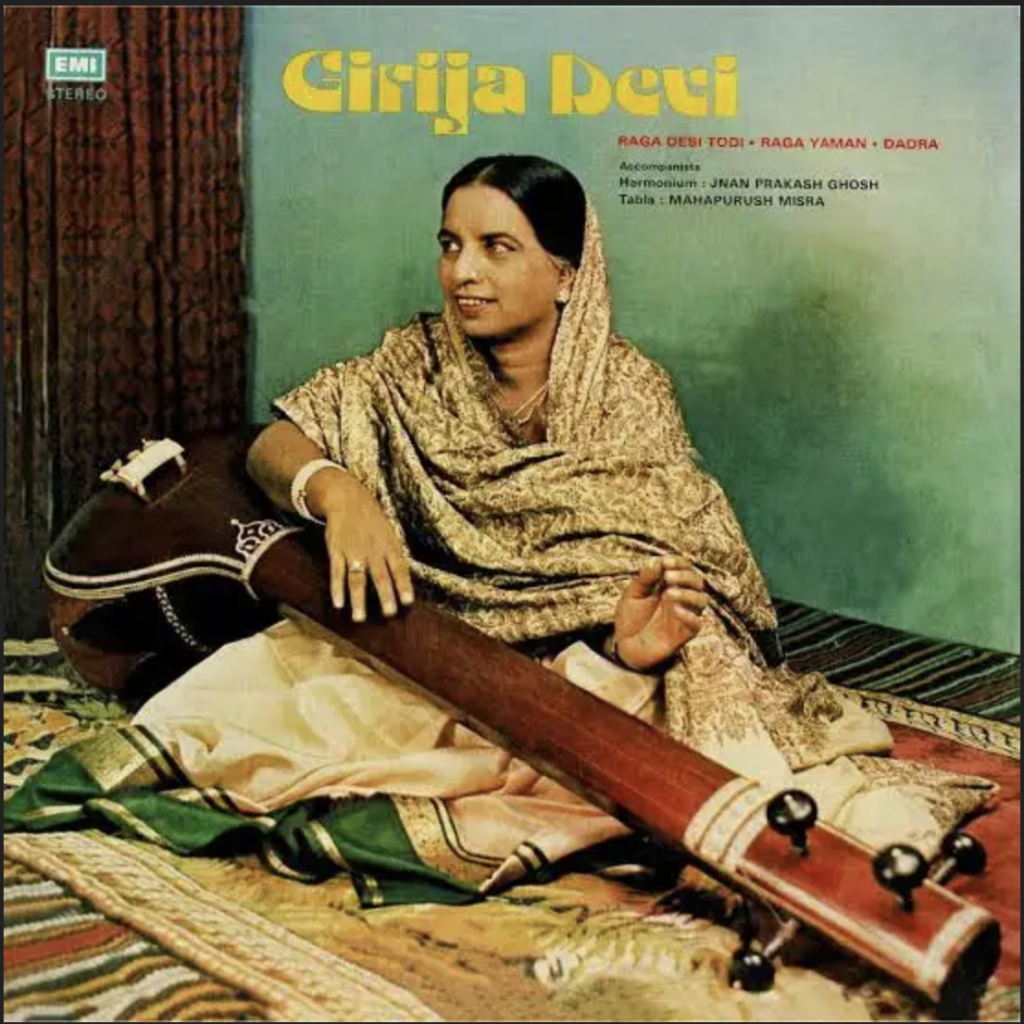
Her association with the ITC Sangeet Research Academy in Kolkata and Banaras Hindu University reflected this commitment. When she moved to Kolkata in 1978, she challenged the conventional image of the distant, unapproachable guru. She was known for her warmth, generosity, and maternal affection, creating an environment in which students could learn through both formal instruction and everyday experience.
Her disciples were part of her extended family. They shared meals, helped with household chores, and absorbed the nuances of music by living alongside their teacher. Her fondness for preparing matar-chuda, a traditional Banarasi dish made with flattened rice and peas, and serving it to her students herself became a memorable expression of this closeness.
For Girija Devi, the guru-shishya parampara involved much more than the transmission of technical knowledge. It required discipline, dedication, patience, and an understanding of music as a way of life. Her students encountered not only an exacting musician but also a mentor who took a personal interest in their growth.
Among the musicians associated with her teaching and musical legacy are Malini Awasthi, Sunanda Sharma, and Dalia Chakrabarty, who have carried forward aspects of the traditions she so passionately upheld. Through her disciples and the many musicians, she inspired, her influence continues to reach beyond the concert hall.
Girija Devi was also a firm believer in rigorous training and sustained hard work. She expressed reservations about televised reality shows that propelled children into instant fame without necessarily providing the prolonged training required for artistic maturity. She was concerned, too, about the disappointment experienced by children who failed to reach the top.
Her alternative vision was constructive: rather than concentrating prize money on a single winner, she suggested that it could be used to train several children under the guidance of accomplished gurus. Such an approach, she believed, would create wider opportunities for learning and strengthen the foundations of India’s musical heritage.
Her concern was ultimately about continuity. Great traditions could survive only when knowledge was passed on patiently, students were given opportunities to learn, and the next generation was encouraged to pursue music with seriousness and commitment.
Despite her extraordinary achievements, Girija Devi continued to harbour a dream that remained unfulfilled during her lifetime: the establishment of a music academy in Banaras.
As she told me during our meeting in 2001, she had been seeking land for such an institution for several decades, but nothing had materialised. The aspiration was characteristic of her outlook. Having devoted her life to preserving the Banaras tradition, she wanted to create a lasting institution where its music could be taught, studied, performed, and transmitted to future generations.
Her death on October 24, 2017, left this dream unresolved. Initiatives reported in connection with converting her former residence into a dedicated cultural and arts centre offer a possible avenue for honouring her memory and preserving the heritage of the Banaras Gharana. Such a centre could serve as more than a memorial: it could become a living space for music education, research, performances, and the documentation of regional traditions.
The fulfilment of this vision would be a fitting tribute to an artist who understood that preserving a musical heritage requires more than admiration for its great performers. It requires institutions, teachers, students, and sustained opportunities for learning.
Girija Devi’s passing marked the end of an era, but her legacy remains deeply etched in India’s cultural memory. She was a crucial bridge between the intimate world of courtly and salon music and the modern public concert stage. By bringing the expressive art of the bai-jis into the wider world of classical performance, she helped challenge social prejudice and expand the possibilities for women musicians.
She was also a foremost custodian of the musical heritage of Banaras and the Purab Ang. At a time when other gharanas enjoyed considerable prominence, she stood firmly by her own tradition, preserving its dialects, melodies, poetic expressions, and emotional nuances. Through her performances, she ensured that these musical treasures remained vibrant and accessible to new generations.
Yet to remember Girija Devi only through her achievements, awards, or contribution to musical history would be to overlook the quality that made her singing so extraordinary: its humanity.
She was a master storyteller who used notes instead of words. In a thumri such as ‘Nadiya Bairan Bhayi’, the anguish of a woman separated from her beloved becomes almost palpable. In her kajris, one can sense the anticipation of the monsoon and the relief of the first drops of rain upon parched earth. Her music could be playful and teasing, tender and vulnerable, or charged with spiritual longing. It was never a sterile academic exercise; it was deeply expressive, immediate, and moving.
She embodied the warmth of a mentor, the resolve of a guardian of tradition, and the brilliance of an extraordinary artist. She was the voice of Banaras, a city where music, devotion, life, and death have long been intertwined.
Girija Devi may have left this world, but she has not left the music she loved, the students she nurtured, or the city whose soul she so beautifully expressed. In her timeless recordings, in the voices of those who carry her tradition forward, and in the memory of everyone fortunate enough to have heard her sing, she lives on.
Her music remains her most enduring gift: a living testament to the cultural soul of Banaras and to the deepest emotions of the human heart.