
The conflict between Saudi Arabia and the Houthi forces is acquiring disturbing dimensions every day and turning into a full-fledged war between the two sides. The world is looking on with exasperation at this new theatre, which not only involves the two parties but also has a direct impact on yet another important shipping route. The shock point is Bab al-Mandeb, where frequent blockages of the strait restrict and often stop the movement of all types of cargo between Asia and Europe. Off and on, this crisis has gone on for the last few years; this time around, however, it has turned a new leaf, with ground forces pitted against each other relentlessly. The Houthis, who after 7 October 2023 had concentrated their attacks on Israel, have now turned on Saudi Arabia, not for any obvious economic gain but purely over what they call territory occupied by Saudi Arabia. The Strait of Bab al-Mandeb, a passage of about 26 kilometres at its narrowest between Yemen and Djibouti, lies close to Houthi-controlled regions of Yemen and became the Houthis’ first choice for gaining the upper hand in this conflict, a lesson learned from the blockade of the Strait of Hormuz.
It is said that desperate times cause desperate measures. The traditional safety net provided by the United States to the countries of West Asia for decades is being evaluated critically by the regional countries in the aftermath of the US–Israel–Iran conflict, which dragged various regional countries into its larger arena. In a measured and well-calculated tactical move, Iran chose to attack the neighbouring Gulf countries that have strong and well-established defence treaties and alliances with the United States. Even the stationing of US forces in countries like Kuwait, Qatar, the UAE and Saudi Arabia could not prevent Iran’s attacks on the oil and gas infrastructures. There was significant collateral damage to the vital installations especially the energy infrastructure of these countries from the Iranian missile attacks. The United States did not come forward to defend them in the manner anticipated, and thousands of US troops and air force bases provided very little comfort. These vulnerabilities showed that the war was not limited to Israel, the US and Iran but had drawn the neighbouring countries into a larger arena.
Saudi Arabia was particularly affected by the blockage of the Strait of Hormuz, the outlet for most of its oil exports. It had to divert a substantial part of its oil traffic through the East–West pipeline to the Red Sea port and oil terminal of Yanbu, expecting that oil would continue to move, with the advantage of the Red Sea on the western side of the Kingdom, by the shipping route via Bab al-Mandeb to East Asia and the Far East. With the blockade of that strait by the Houthis, even this opening is no longer available. Saudi Arabia at the same time has also been fighting the Houthis in the south. The Houthis are backed by the Iranian regime and continue to receive huge military and financial support. Some UN panel reports indicate that the IRGC and Hezbollah have provided active military support, including advanced drones, ballistic missiles, cruise missiles and attack boats, to the Houthis fighting the Saudis and Israel. The Iranian regime has, however, always denied any support to the Houthis other than political.
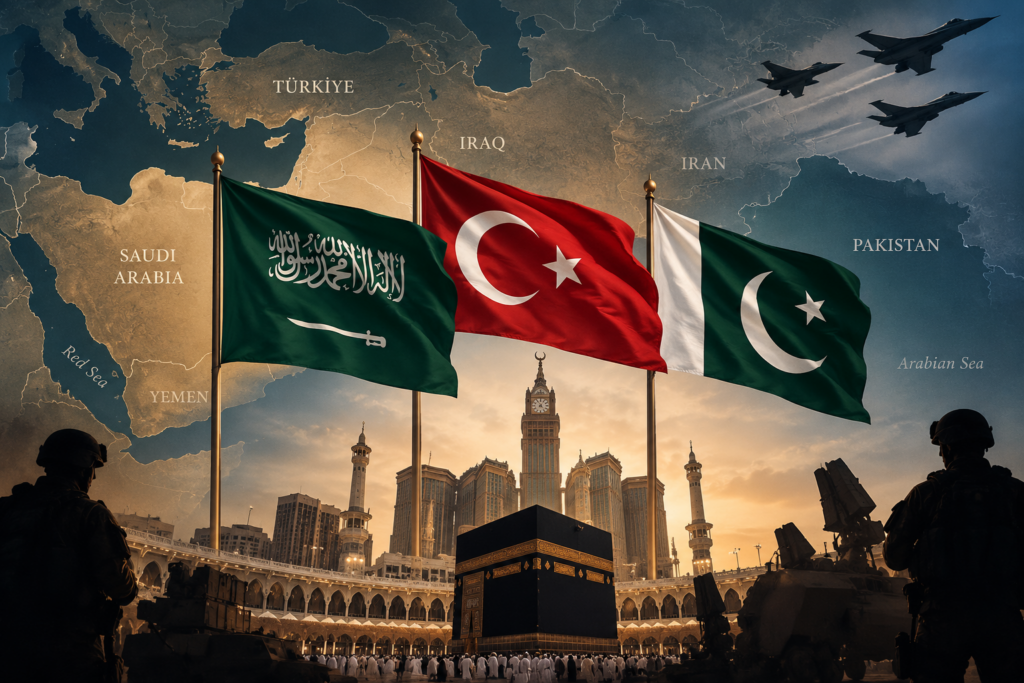
These developments have led the countries of West Asia, especially Saudi Arabia, to think beyond the United States for their defence and security. Despite thousands of US troops being stationed in the Kingdom, and its being one of the most important recipients of US arms, Saudi Arabia with the recent developments had to reconsider its traditional security umbrella provided by the US . The new assessment has resulted in a tri-country defence alliance, termed the Makkah Defence Alliance (MDA), involving Saudi Arabia, Turkey and Pakistan. It has a provision copied from Article 5 of NATO, that an attack on any of the countries shall be considered an attack on all, and is declared to be purely defensive, targeting no country. It has already acquired an institutional framework and organisational set-up under a Secretary General, headquartered in Riyadh. This major development is being welcomed, and at the same time viewed sceptically, by many stakeholders in the region and across the world.
The Gulf War and the Limits of the Security Umbrella
The ongoing Gulf War has exposed many fissures and loopholes in the assumed facets of national security – umbrella guarantee of sorts to the oil-producing countries of the Arab world. The over six-month-old war, which is difficult to predict to end anytime soon, began in February 2026 as a conflict involving primarily Iran, Israel and the United States. It has witnessed hot conflict, the use of the latest war machines, missiles, drones and fighter jets, and a looming threat of nuclear escalation.
The war continues to reflect the vulnerability of national security that oil-rich countries with very limited armed forces and equipment often contract out to outside powers. It has also shown that future wars will not be confined to border conflicts between two countries fought by land forces, including infantry and artillery, but will most likely be air battles involving air forces, aircraft carriers, missiles, drones, submarines and associated defence systems. Iran has been at war with Israel and the United States without a border with either, and without ground troops getting involved. This poses a serious question about the capabilities and preparedness of countries that are at war, or likely to be at war, with countries that are not necessarily their neighbours.
For many decades the security of several countries in this region, including oil-rich Arab countries like Saudi Arabia, the UAE, Qatar and Kuwait, and Israel, was in effect contracted out to the United States, with ground forces stationed in these countries and aircraft carriers guarding the seas around. No major ground invasion had been anticipated after the operations in Iraq and Afghanistan. In the present crisis, a midway change of strategy by Iran resulted in attacks on infrastructure and installations in the neighbourhood that had hitherto been safeguarded by the United States through its physical presence.
Nuclear deterrence too did not deter the warring nations, although Israel and the US are both nuclear powers and primarily targeted Iran’s growing nuclear potential. The conflict has also been watched by four more nuclear powers, Russia, China, India and Pakistan, and the NATO which carefully studied the developments and, keeping their own national interests in view, undertook diplomatic and other measures. None of them, however, became directly involved.
Other than the three countries directly involved, Saudi Arabia, the UAE, Kuwait and Qatar, which had a sizeable presence of US forces and defence equipment, were the worst hit. It was not collateral damage that these countries suffered but a direct attack by Iran on their installations and infrastructure in response to the attacks on Iran by Israel and the United States. The question of whether the US can protect these friendly countries remains. Bothered by security vulnerabilities they never anticipated, the affected countries are evidently looking for better defence mechanisms and agreements to avoid a similar situation in future.
Saudi Arabia, the most important of the Arab countries and a major oil producer, decided to go in for a different multi-nation defence treaty. Pakistan, the only Islamic nuclear country, with over half a million armed personnel and a sizeable fleet of air and ground equipment, was the first choice. Turkey, although not part of the conflict in any way, is a member of NATO with the second-largest armed forces in that network and huge armament and defence production capability. Together the three countries command over a million armed personnel, a sizeable air force and, of course, nuclear capability. As a NATO country, Turkey is also covered by Article 5 of the NATO treaty, which has been taken as the cornerstone of the present alliance: any attack on any one of the countries shall be treated as an attack on all the three. The detailed text of the Makkah Defence Alliance is not yet in the public domain, although its first meeting has already taken place in Turkey and a secretariat has been established in Riyadh with a Secretary General to head the body.
Media reports quoting the respective governments have carried statements by the leaders and analyses by semi-government think tanks, but the details are yet to be made public. The trilateral pact has generated debate across the globe, ranging from its potential impact on the new world order and the evolution of an unorthodox and unprecedented West Asian security scenario, to the scepticism that, since it appears to lack the operational details of NATO, it could at best be purely intentional and aspirational.
The Saudi–Pakistan defence alliance evolution
The Makkah Defence Alliance (MDA) of 7th August 2026 must also be viewed against the backdrop of the Strategic Mutual Defence Agreement (SMDA), a bilateral treaty signed by Pakistan and Saudi Arabia on 17 September 2025, well before the US–Israel–Iran conflict began in February 2026. SMDA merely cemented a relationship between the two countries dating back to the 1960s. Its fundamental cornerstone, copied from NATO, is that aggression against either country shall be considered aggression against both. It was signed in Riyadh by Saudi Crown Prince and Pakistani Prime Minister. However its text has not been officially published. Apart from mutual assistance in defence capabilities and the stationing of additional Pakistani forces in Saudi Arabia, the question of nuclear sharing by Pakistan with Saudi Arabia remained unclear.
The only authentic official document on the SMDA is the joint statement issued by the Saudi government following the Pakistani Prime Minister’s state visit. It stated:
“This agreement, which reflects the shared commitment of both nations to enhance their security and to achieve security and peace in the region and the world, aims to develop aspects of defence cooperation between the two countries and strengthen joint deterrence against any aggression. The agreement states that any aggression against either country shall be considered an aggression against both.”
The lack of operationalisation of this pact was obvious during the US–Israel–Iran conflict, which in a big way affected a number of Gulf countries, including Saudi Arabia, whose infrastructure came under Iranian missile attack. At no point did Pakistan come to Saudi Arabia’s support against the missile attacks from Iran. Nor did Pakistan, in its mediating role, invoke its pact with Saudi Arabia to sensitise Iran and persuade it to desist from attacking Saudi infrastructure and facilities.
The Makkah Defence Alliance
The alliance was signed in Makkah on 7 August 2026 by Turkey, Saudi Arabia and Pakistan. Its most crucial aspect is an agreement on the lines of NATO’s Article 5, reflecting collective deterrence: an armed attack on one is to be treated as an attack on all.
The alliance has a secretariat in Riyadh headed by a Secretary General for a term of three years; the first Secretary General, it has been decided, will be from Pakistan. Its primary focus is interoperability, joint defence exercises, counterterrorism and defence industrial cooperation, including joint research and development and production. The interoperability envisaged could well place Turkey, with its huge defence manufacturing base, at the centre of the alliance.
Many more countries of the region, especially Islamic countries, were expected to join the alliance. However, apart from a few media reports and statements, no concrete proposal to join has yet been forwarded by any country, either of the region or of the larger Islamic group. Media reports suggest that Egypt is reconsidering joining, subject to constitutional and legal commitments, and that Bangladesh has been very positive and may be inclined to join in future. Speculation also covers Jordan, Azerbaijan, Qatar, Kuwait, Iraq, Syria, and even a few African countries. Interestingly, Iran has appreciated the effort of the regional countries to come together in a defence alliance. Its positive feedback arises from an understanding that the alliance could well be oriented against the threat posed by Israel. This, however, remains a grey area, and the signatories have not clarified whether the alliance is directed specifically against any country or group of countries, including Israel or Iran.
In an article in arabnews.com, Prince Turki al Faisal wrote that, it is primarily defensive in nature and broadly a collective security arrangement. Through the alliance, Turkey, Saudi Arabia and Pakistan “have the potential to emerge as a major strategic actor capable of confronting threats directed against them or the wider region.” The Middle East Council on Global Affairs, in its paper of 2 September 2026, (The Makkah Joint Defence Agreement: The Making of a New Security Architecture – Situation Assessment, September 2026), detailed the developments from 7 August 2026, when Saudi Crown Prince Mohammed bin Salman, Turkish President Recep Tayyip Erdogan and Pakistani Prime Minister Shahbaz Sharif signed the agreement at Al-Safa Palace in Makkah. It stated that the trilateral agreement represents a major breakthrough in regional security and could be the basis for a broader, organic security architecture, one built by regional states for themselves rather than assembled by an outside patron.
The text of the agreement has not yet been made public, leaving it open to discussion and assumption regarding its duration, ratification, withdrawal, geographic scope, accession mechanism and command-and-consultation machinery. It is being termed a NATO-style agreement, with the Article 5 language that an attack against one member shall be considered an attack against all. Article 5 of NATO itself contains a commitment to take “such action as it deems necessary”. As in NATO, a Secretary General heads the secretariat in Riyadh.
The alliance has been in the making since 2021, originally as an understanding among Egypt, Saudi Arabia and Turkey, and was almost formed after 7 October 2023, when Hamas breached the borders of Israel and Israeli military action followed in Gaza and beyond. During this period of negotiation, Pakistan also cemented its six-decade-old relationship with Saudi Arabia into the bilateral SMDA on 17 September 2025. The alliance was finally signed by the three on 7 August 2026, leaving the door open for Egypt to consider and join early. As the text is not public, it remains unclear whether any country/countries are named against which the alliance is directed. The dominant thinking among the countries of the region was evidently to take responsibility for their own security and to develop a collective security architecture that could include as many members as NATO does in Europe.
The NATO, The CENTO and The MDA
A broad comparison of NATO, CENTO and the MDA shows some similarities. NATO continues to provide a strong defence framework for its European members and also a nuclear umbrella. CENTO, which evolved during the Cold War, was designed by the United States and the United Kingdom as a kind of northern tier against the Soviet Union, driven purely by external Western interests and lacking strong provisions, it collapsed after the 1979 Iranian revolution.
It is important to consider Article 5 of the North Atlantic Treaty, signed in Washington DC in 1949, which for the first time established the principle of collective defence after the Second World War. It reads:
“The Parties agree that an armed attack against one or more of them in Europe or North America shall be considered an attack against them all and consequently they agree that, if such an armed attack occurs, each of them, in exercise of the right of individual or collective self-defence recognised by Article 51 of the Charter of the United Nations, will assist the Party or Parties so attacked by taking forthwith, individually and in concert with the other Parties, such action as it deems necessary, including the use of armed force, to restore and maintain the security of the North Atlantic area.
Any such armed attack and all measures taken as a result thereof shall immediately be reported to the Security Council. Such measures shall be terminated when the Security Council has taken the measures necessary to restore and maintain international peace and security.”
Whereas NATO provided a collective defence mechanism for Europe and North America, the Central Treaty Organisation (CENTO), originally known as the Baghdad Pact, was signed in 1955 initially by Turkey and Iraq and subsequently joined by Pakistan, Iran and the UK. It was largely a West Asian defence alliance, but it differed from NATO in that Article 1 of CENTO spoke of cooperation rather than an automatic military response. Article 1 reads:
“Consistent with Article 51 of the United Nations Charter, the High Contracting Parties will cooperate for their security and defence. Such measures as they agree to take to give effect to this cooperation may form the subject of special agreements with each other.”
Although the official text of the MDA remains undisclosed, statements by the leaders of the three countries indicate some of its features. It is a three-country pact providing that “any armed attack against any one of the three states shall be regarded as an attack against them all”, quite similar to Article 5 of NATO. The mandate of response, a commitment by the members in the case of NATO, was non-binding in CENTO and is, to a large extent, still evolving in the case of the MDA. The command structure, however, is similar in NATO and the MDA.
Broadly, Saudi Arabia provides deep capital and financial backing, Turkey advanced indigenous drone and military-industrial manufacturing, and Pakistan combat manpower and the deterrent weight of its nuclear arsenal. The MDA’s first major test is expected to be a decision to intervene on behalf of Saudi Arabia in its fight against the Houthis of Yemen.
According to the New York Times, the agreement closely mirrors NATO’s collective defence structure, but the absence of an official text leaves its exact operational scope and the legal triggers of the mutual defence mandate unclear. The Times of Israel has noted a distinct gap between paper commitments and military action: despite over 8,000 troops being in the Kingdom, Pakistan and Turkey have shown little appetite to be dragged into a direct kinetic conflict with Iran or its Houthi proxies.
A Defence Alliance: Against Whom?
The current situation throws up two scenarios. The first is the apprehension of an open Iranian attack on Saudi Arabia’s vital energy installations in case of escalation in the US–Israel–Iran conflict. The second is the emerging scenario of a full-fledged war between Saudi Arabia and the Houthis of Yemen. In both, the threat from Iran or from the Houthis is only to Saudi Arabia and not to the other two members of the alliance.
It remains to be seen whether active involvement by Pakistan and Turkey is contemplated in the near future. The first test of the MDA is most likely a combined action by Turkey, Pakistan and Saudi Arabia against the Houthis of Yemen. Regional countries and the world will watch it as a test of the alliance.
Another scenario is Turkey’s border disputes with Greece, which are under the cover of NATO; there is at present no major border conflict between Turkey and Iraq or Syria. Turkey has very strong views against Israel and in support of Palestine, but invoking collective defence would arise only if Turkey were attacked by Israel, which is unlikely at present.
Pakistan, a conventional and nuclear power with comfortable bilateral relations with Iran, does not seem to have any threat perception from its western side. It is also unlikely that the MDA would be invoked to bring direct support from Turkey and Saudi Arabia in a war between Pakistan and India. Saudi Arabia already has strong ties with India, which itself acts as a deterrent. The I2U2 grouping of India, Israel, the UAE and the USA also gives India a different status, and the MDA continues to remain a West Asian alliance for the West Asian region.
MDA Defence Capabilities
As evident from reports including SIPRI, the IISS Military Balance and Global Firepower 2026, the three MDA countries together have about 1.4 million military personnel, around 3,500 aircraft, over 6,000 battle tanks and around 340 naval assets. Pakistan has 660,000 active personnel, over 1,200 aircraft, 120 naval assets and a defence budget exceeding $9 billion annually. Turkey has 480,000 active personnel, over 1,100 aircraft, over 192 naval assets, over 2,000 tanks and a defence budget of over $51 billion annually. Saudi Arabia, the largest importer of American armaments, has over 247,000 active personnel, over 900 aircraft, 1,085 tanks, over 30 naval assets and a sizeable defence budget of over $63 billion annually.
The combined military capability of the three founding members far exceeds that of any other country in West Asia. Saudi Arabia, with its financial backing as the top oil exporter, Turkey, as NATO’s second-largest military with a major defence industry, and Pakistan, with huge personnel strength and as the only nuclear-armed Muslim country, make the MDA a formidable alliance. Its effectiveness, however, is yet to be seen: despite Saudi Arabia’s ongoing conflict with the Houthis, no decision has been taken by the MDA countries to get actively involved.
How Israel Looks at the MDA
The MDA has evolved in view of the weakening of the US umbrella for West Asian countries, including Saudi Arabia and the Gulf nations, and is largely meant to defend against the threat from Iran to Saudi Arabia. Israel, however, is wary of the alliance in view of Turkey’s hostility and its support to various factions fighting Israel. Israel is apprehensive that the MDA could constrain its actions against Turkey, Saudi Arabia or other countries likely to join in future, including Syria.
A recent paper by the Israel based Misgav Institute for National Security, (The Makkah Pact: From Military Threat to Strategic Opportunity), noted that, “the alliance appears first and foremost to be a response to the danger Iran poses to the region and to growing doubts about the reliability of the American security umbrella; yet Ankara’s assurances that it is not directed against any particular country cannot reassure Israel. Given Turkey’s overt hostility towards Israel and its ambition to establish hegemony in the eastern Mediterranean, Israel is ready to assume that the new concentration of power will also be directed against it, directly or indirectly”. The leaders of the MDA have however clearly stated that the alliance is not against any country, including Israel, and that it is merely a defence agreement.
Latest Developments
Since the MDA was signed on 7 August, its secretariat has been set up in Riyadh under a Secretary General, and the appointment has been made. On 25 September, Reuters reported that the Speaker of the Turkish parliament had said the defence pact between Turkey, Saudi Arabia and Pakistan could turn into a broader pact for the Muslim world that includes Iran. On the same day, the chiefs of defence forces of Saudi Arabia, Turkey and Pakistan met in Riyadh and expressed what was described as a shared determination to translate their commitment under the MDA immediately into effective military cooperation. It is yet to be seen whether any joint military operation against the Houthis in the south of Saudi Arabia is planned or under way or the statement is purely rhetorical.
Global Military Spending on the Rise
A SIPRI report of 27 April 2026 highlighted that military spendings in 2025 which rose by 14% in Europe and by 8.1% in Asia and Oceania. The top three spenders, the USA, China and Russia, together spent $1,480 billion, or 51% of the global total.
In 2025, according to SIPRI, global military expenditure jumped to $2,887 billion, rising continuously for the last 11 years; its share of global GDP, at 2.5%, is at the highest level. The main contributors to the growth were Europe, which increased spending by 14% to $864 billion; Russia, up 5.9% to $190 billion; China, up 7.4% to $336 billion; Japan, up 9.7% to $62.2 billion; India, the fifth-biggest spender in the world, up 8.9% to $92.1 billion; and Pakistan, up 11% to $11.9 billion. Military expenditure in the Middle East reached an estimated $218 billion. The growing expenditure on defence has not unfortunately brought back the debate on Defence vs Development debate this time around. Is the world choosing war over Peace? must bother all.
Military alliances formed after the Second World War and after the end of the Cold War, in the aftermath of various regional conflicts, have been by and large been short-lived. The only surviving major defence treaty continues to be NATO, which has let the European nations grow, develop and improve the well-being of their citizens by concentrating on priorities other than defending their territories with large armies and armaments. NATO has given over two dozen countries, protection, cover and a sense of security that is fundamental to Europe’s development today. It is also time for the world to move from defence alliances and treaties to mutually acceptable economic alliances and peaceful coexistence.
To quote Harry S. Truman on the signing of the NATO treaty: “In this pact we hope to create a shield against aggression and the fear of aggression, a bulwark which will permit us to get on with the real business of government and society.”
It is hoped that the MDA and other such defence alliances in future will only be oriented towards ensuring peace and shared prosperity for the humanity.