
By Ajay Mankotia
What do call a person who was an Adonis and a Merlin; who had both altitude and attitude ; who , not content with his incredibly good looks and a glowing skin , wore a large red bindi to complete the circle; who had men marveling at his musical craftsmanship , and women swooning over his stage presence ; whose hands not only ruled supreme over the music instrument , but could also wield a gun to bring unruly audiences to heel ; who fought for the dignity and equal treatment for his fellow co-travelers?
That would be Pandit Kishan Maharaj, of Benares Gharana. With his thunderous dominion over the tabla, exceptional clarity, spontaneous brilliance, virtuosity, compositional artistry, he had a profound impact on Hindustani classical percussion. He continues to inspire generations of musicians and listeners. His rhythm echoes beyond time.
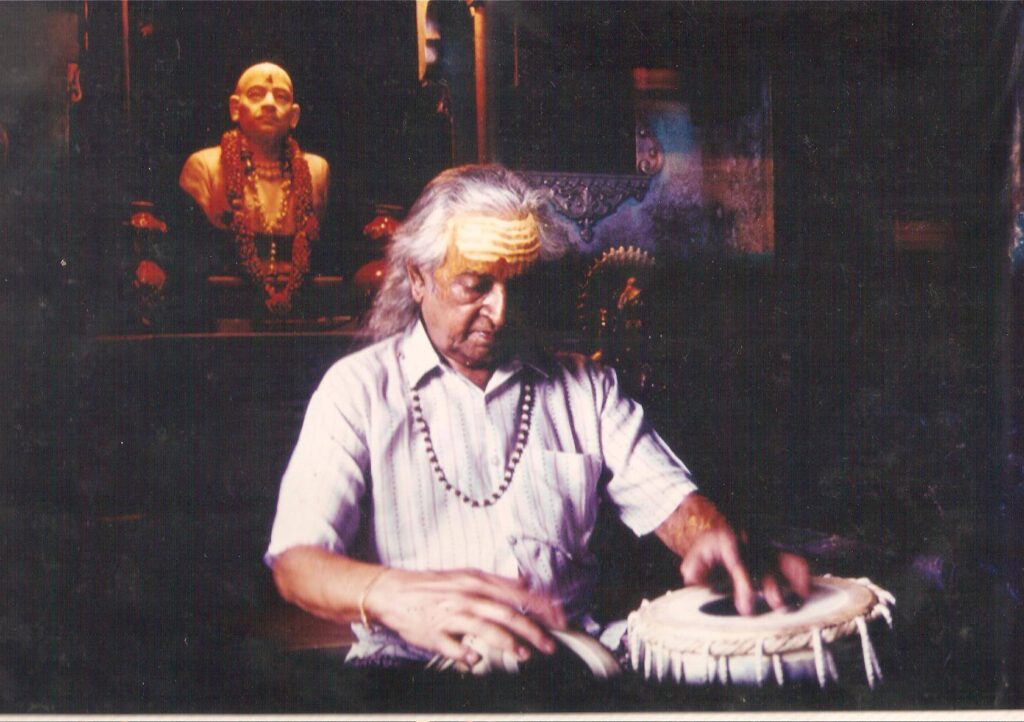
It was not for nothing that the great tabla maestro Ustad Ahmed Jan Thirakwa told Pandit Kishan Maharaj – “Only you and I play the tabla. The rest play Tablis”.
When I met him the first time in Varanasi in 2001, I was struck by his aura. The first port of call at his residence was his music room where he proceeded to give me a 15-minute demo of his unearthly talent. There was a regal splendour, a grandeur, about his presentation.
After the mesmeric music session, we proceeded to the drawing room where we partook of jalebi and dahi, kachauri, and kulhad tea. We talked of his life and his music; about the city and his Gharana (as well as its future); the present status of Hindustani classical music and its direction. He was clear- headed, knowledgeable, passionate.
I would meet him several times over the years. Sometimes I would meet him at events where both of us were invited.
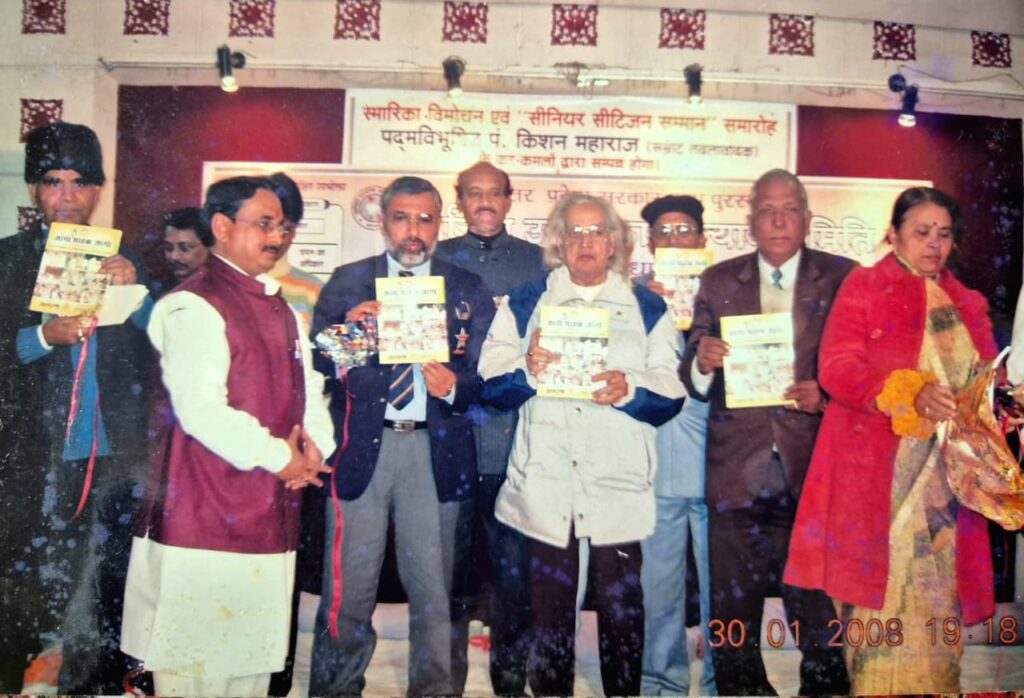
I was in Varanasi when he passed away on May 4, 2008. Today is his death anniversary.
Renowned for his immense power, mathematical precision, complex rhythmic patterns, improvisation and dramatic flair, he had a masterful, versatile ability to ‘accompany’ sitar, sarod, and dance, making him one of India’s most celebrated percussionists. However, in view of his contribution in making tabla a solo instrument, he never allowed anyone to treat him like an accompanist. He was an equal collaborator.
Moreover, at most music shows, the percussionist would be treated as a second-class musician. The sitarist at a show, for example, would get the pride of place in the announcements, name splashed on the publicity. Pandit Kishan Maharaj was able to transcend that injustice and command an equal status.
He mastered complex tihai patterns and demonstrated unparalleled speed and dexterity in gat, tukra, and paran styles. Known for utilizing a kneeling sitting position rather than traditional lotus posture, he added a dramatic flair to his performances. As if that was not enough, he would enhance the theatricality by using generous powder on his tabla to create a fog on stage.
He was born into a family of professional musicians in Kabir Chaura, a culturally rich area of Varanasi. His father, Pandit Hari Maharaj, was a well-known tabla player. After his father’s early death, Pandit Kishan Maharaj was trained under his uncle Pandit Kanthe Maharaj, a towering figure in the Benares tabla tradition.
The Benares Gharanais known for powerful strokes and dynamic presentation and emphasis on dumdaar (resounding) compositions, complex rhythmic variations (laykari), Tukra, Paran, and Chakradar styles, use of bol-baant (division of syllables), and complex tihai patterns.
Pandit Kishan Maharaj not only imbibed the said characteristics but did a significant value addition by blending intellectual complexity with expressive energy, improvising with mathematical precision, mastering cross-rhythms and sawal-jawab patterns in solo and accompaniment contexts. His special technique on the bayan were amazing. He brought an extraordinary mazedari-the romance, the pleasure into his performances.
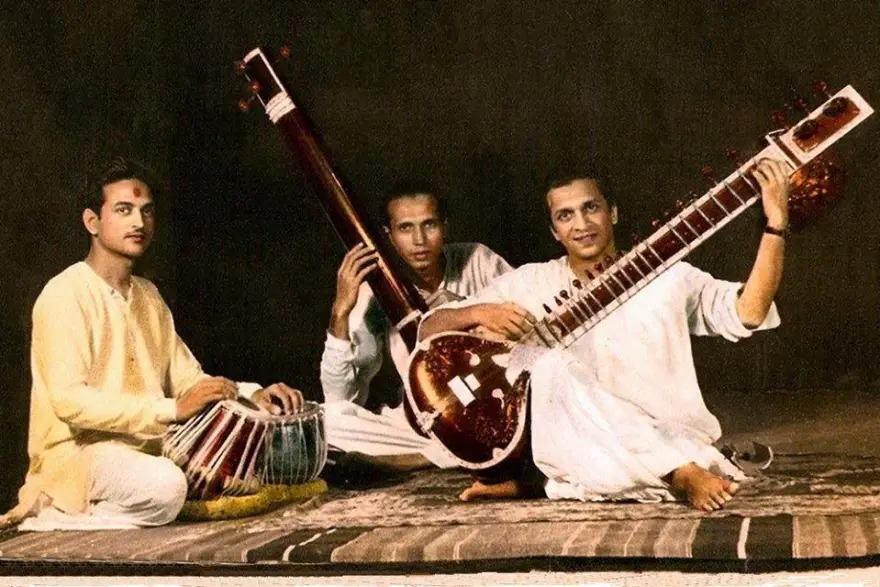
He collaborated with nearly every great Hindustani classical musician of his time: Pandit Ravi Shankar (sitar), Ustad Vilayat Khan (sitar), Ustad Ali Akbar Khan (sarod), UstadBismillah Khan (shehnai), Pandit Bhimsen Joshi, Kesarbai Kerkar, Girija Devi (vocal). What jugalbandi performances they were! His collaborations saw two artists trying to complement each other and seeing how far they could raise the bar of excellence, and truly understanding and appreciating the talent of each other.
Pandit Ravi Shankar, his collaborator on stage had this to say about him: “Kishan Maharaj could create thunder with his fingers, and silence with a stroke.”
In an interview Pandit Ravi Shankar recalled that Kishan Maharaj and he were called the Ram Lakshman of the Indian musical scene in those days. Both were incredible performers, hopeless romantics and incredibly good looking. “I don’t think any of the girls even listened to what they were playing,” Pandit Hari Prasad Chaurasiahad remarked once. Pandit Ravi Shankar had agreed: “It is true that people used to come not just to hear but also to see us together. Honestly it was something quite fantastic.”
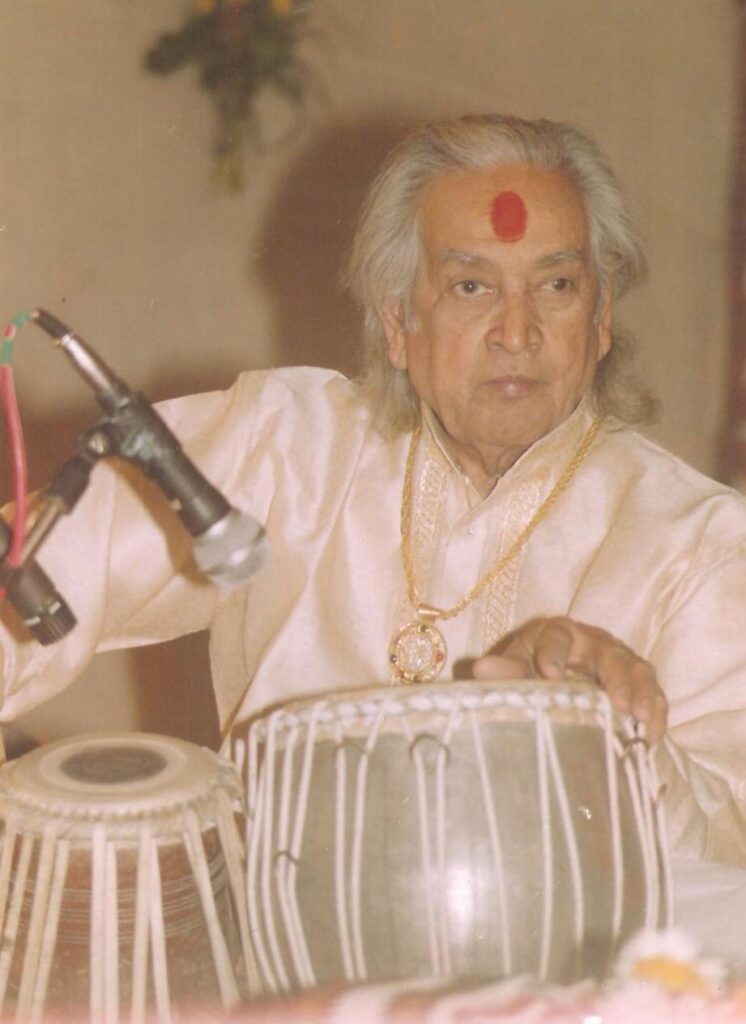
And how did the perfectionist match up with the devil may care tabla maestro on stage who lived and played on his own terms?
“That was Kishan’s personality but somehow he was never like that with me, and I adjusted to that little flamboyancy of his, so I never had any problem,” laughed the maestro.
He remembered one such incident where they were playing at an open fair, and the audience was noisy and rural and in thousands selling cows and camels. “I saw Kishan walk on stage with a gun. I laughed and said what are you doing? And he said watch the fun. After we sat down, he took the gun, pretended as if he was cleaning it, fired two shots in the sir, aimed it towards the public and did a few little gimmicks like that. The audience became very quiet! Of course we didn’t play too long, quickly played two gats and finished it but it was quite a funny experience.!”
He further stated: “He brought this wonderful laya unlike the average tabla players who were playing mostly teen taal. I happened to popularize different talas in my recital which also inspired both (Allah Rakha and Pt Kishan Maharaj) of them to play different talas and things like that which was very unique.”
Said Pandit Shiv Kumar Sharma: “Accompaniment I feel is a very very difficult art form. To accompany different musicians, create their kind of music, understanding the style of the musician is not easy. Kishan Maharaj ji was one such great tabla player who created a different style of tabla accompaniment where he merged with the main artist, whether it was instrumental music, vocal music, or kathak dance-he excelled in everything.”
His tabla solos were crowd-pullers — filled with complex compositions, humour, and explosive energy., featuring bold technique, mathematical variations, and a deep connection to tradition. He would hold the audience spellbound.
He did not play for money or to please the audience and did not indulge in cheap gimmicks. He had no use for the glamorous rela on tabla – rapid continuous percussive movements which most tabla players play towards the end of their concert. He was of the opinion that a table player needed to show his talent without the frivolousness.
He had great dignity and would not compromise on his principles. In that era, the great maestros and their children would play with the courtesans at their kothas-but Pandit Kishan Maharaj refused. He felt that it was disrespectful to the Gharana and its reputation.
Sitara Devi recalled how the King of Afghanistan had hosted a cultural team from India and Kishan Maharaj refused to sit on the carpet and play as the King and his son sat on chairs. “He told them- “Your highness, my art is divine for me and playing on the floor will be disrespectful to the divinity that symbolizes my art. So, I will leave now. The King was very kind and stopped him, had a really nice stage arranged and then Kishan Maharaj played before them.”
Sitara Devi remembered the dancers and other women who flocked to the handsome, and mesmerizing young tabla wizard. “I knew what these girls had in mind, but you know he was so handsome, such a great intellect, so brilliant in his craft, it is only natural that people would be attracted to all that. But he was very protective about me and would start frowning if any of my male admirers got too close, shooing them away and telling me to get moving.”
His exploits at crowd control, resulting from his anger at lack of respect for the artists, are legendary and every musician has a story to narrate.
Habib Kalavant whose father Nizamuddin Khan was a renowned Sarangi player from Rajasthan remembered one incident of Pandit Kishan Maharaj’s temper fondly. “Once Kishan Maharaj ji was playing at a concert. Sitting in the first row was a gentleman who kept talking on the cell phone, walking in and out of the auditorium. Kishan Maharaj noticed it and jumped down 6 feet from the stage, gave the guy a big slap and ordered him out and before the main artist who was busy with his alaap even knew what had happened, leapt back and sat on the stage!”
Sandeep Das, Grammy -winning tabla player, and disciple of Pandit Kishan Maharaj had this to say about a show where every famous artist was being booed off the stage:
“Kishan Maharaj had someone carry his tabla on stage and walked in with a big gun. He told the audience- “My first passion is shooting. It could be shooting people or animals. It depends on how I feel on a particular day. My second passion is tabla which I’m going to play. It’s up to you to decide whether you want to hear my tabla or see my shooting skills.” There was pin drop silence after that. He played tabla solo for about half an hour and then invited Ravi ji on stage and every other artist after that was able to perform.”
Sandeep Das narrated another incident – “Another incident happened when Kathak diva Sitara Devi and Pandit Kishan Maharaj were performing at a wedding and the entire party of wedding guests were drunk and carried guns. They would not let Sitara Devi stop. They told her to dance all night, like Basanti of Sholay. Guruji realized he had to do something so he somehow managed to put his gun to the throat of the bridegroom, and said I’ll shoot him dead, abducted him to the train station, boarded a running train with Sitara Devi, threw their instruments in and made a getaway from that place!”
Yet another incident – “Another time Pt Ravi Shankar, Kishan Maharaj and Sitara Devi had hailed a cab. The driver a six-foot man passed a lewd comment. Before anybody knew what hit him, the six foot plus driver was on the floor because my guruji had punched him so hard!”
He had a sense of humour and presence of mind – attributes evident in the following interview.
Once he was asked on national television by an interviewer that she had heard he had been married thrice. Pat came the reply: “Beti tumne is baat pe to dhyan de diya ki maine 3 shaadiyan ki hain but you didn’t pay attention to my name. Its Kishan-toh izzat to mujhe Kishan bhagwan ki rakhni padegi “.
He took care of his kids from all the three marriages and never let them feel they didn’t have a father. One of his wives, Savita Devi, was the daughter of Siddheshwari Devi, renowned classical singer. His son from another wife Puran Maharaj is a renowned table player and carries forward the tradition of the Benaras Gharana.
He fought for the rights of tabla players. At a time when tabla players were booked for the entire festivals that lasted 7 to 10 days, and had to be available at any hour, it was Pandit Kishan Maharaj who started charging per concert. He stood up not just for what he felt was unfair to him but others as well. Today if the names of all the accompanists are mentioned in the announcements or on All India Radio it is because Pandit Kishan Maharaj fought for that entitlement and won.
Said Sandeep Das- “The Harballabh Sangeet festival were telling me and I have heard it from guruji also that the first time he went to play there he saw that the main artist was on the podium and the accompanying artists were sitting on the floor and playing. My guru ji walks in, doesn’t say anything to the organizer, takes out his revolver, points it at the accompanying artists sitting on the floor and says that from today if I ever see any accompanying artist sitting on the floor and playing, I will shoot them first- and that was the end of that thing forever in that festival. The next item onwards every artist was on the same platform.”
He could talk with crowds and keep his virtue, and walk with kings and not lose the common touch. He would be his most elegant in high class surroundings; at home he would stand on the street and chat away with all the rickshaw wallahs as if they were his closest friends.
He believed in living with honesty and dignity and had no patience with sycophants. He had a deep appreciation for strong people, and those who tried their best to excel and had no patience with weak or lazy people. He was never cowed down by society or any authority. He always spoke his mind. He was a deeply spiritual person, known for his sharp wit, storytelling, and humility. He received many awards including Padma Shri and Padma Vibhushan.
He was a painter, sculptor, poet and a funster. He loved horse riding, hunting and ikka competitions.
He taught many prominent students who carry forward the Benares tabla tradition. He was known for his generosity as a guru, passing on both technique and philosophy. He was very strict with those who learnt from him, but he didn’t just teach them tabla; he taught them about life, about culture and how to conduct themselves.
Pandit Kishan Maharaj died at the age of 84. His death was mourned nationally with the Government recognising him as one of the last great traditional tabla masters of the Benaras Gharana. His end journey was as dramatic as his performances.
Said Sandeep Das – “When a great soul like Pandit Kishan Maharaj leaves his earthly body, humanity and heaven come together to orchestrate the perfect exit. Thousands of people from all religions come out and shower rose petals, garlands, at his body throughout the procession’s journey to the ghats. That showed this man had touched people irrespective of caste, creed or religion.
At the ghat when the body is burned, usually it doesn’t burn evenly all the time and a lot has to be done to ensure it burns quickly. But when his son Puran Maharaj lit the pyre, in seconds the fire was burning evenly. Even the people who work at these ghats and burn thousands of bodies every day were saying- “We have heard from our elders that only when you burn the body of a saint or a siddh atma the body burns like this, within seconds it was like some hand is spreading the fire evenly.” He was truly a man for all seasons, a man who lived on his own terms. As Pandit Birju Maharaj“The tabla became poetry when Kishanji played.” But his achievements went beyond the tabla.
(All Photos credit: Pandit Kishan Maharaj/facebook.com)