
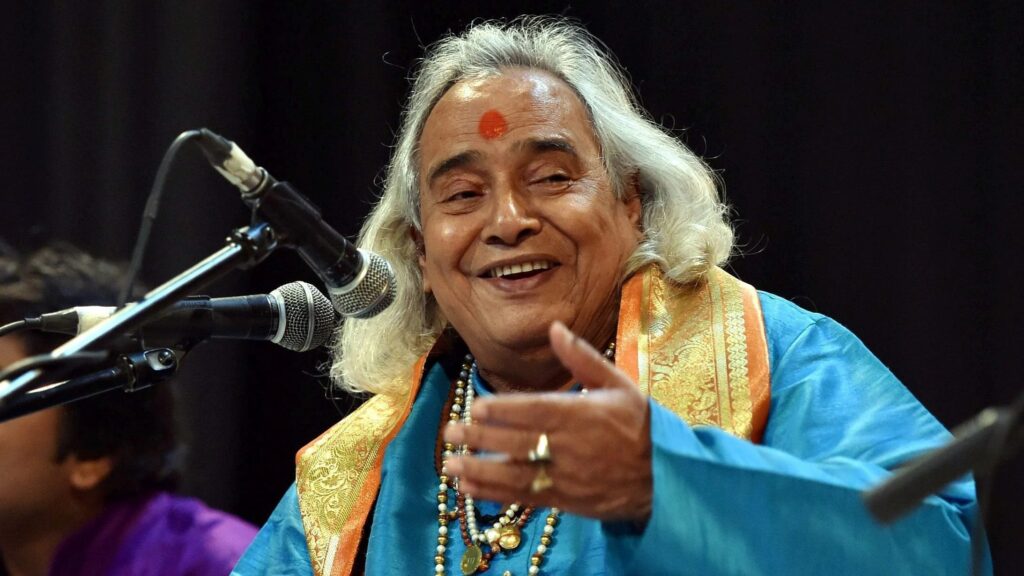
He was as modest as they come, with much to be modest about. Deeply humble, soft-spoken, and rooted in simplicity. Ever smiling. To match his humility, his house was spartan in a spartan colony. It was located in a narrow lane which my official government Ambassador was unable to enter. It had to be parked in a clearing outside and I had to foot it. His music room, where he taught me music for brief period, was frugal, with rudimentary fixtures and furnishing, with some coloured photographs of his with celebrities on the wall, including Amitabh Bachchan’s. He would, like a child, excitedly tell me the story behind each photograph. In 2007, when I first met him, he had been awarded the Uttar Pradesh Sangeet Natak Akademi recognition in 2000, when he was 64. A decade later, in 2010, he would receive both the Sangeet Natak Akademi award and the Padma Bhushan. These would be followed by the Akademi Fellowship in 2019 and, a year later, the Padma Vibhushan in 2020. In a rare departure from character, he had openly critiqued state recognition systems earlier in his career as being “too little, too late” compared to his contemporaries and juniors.
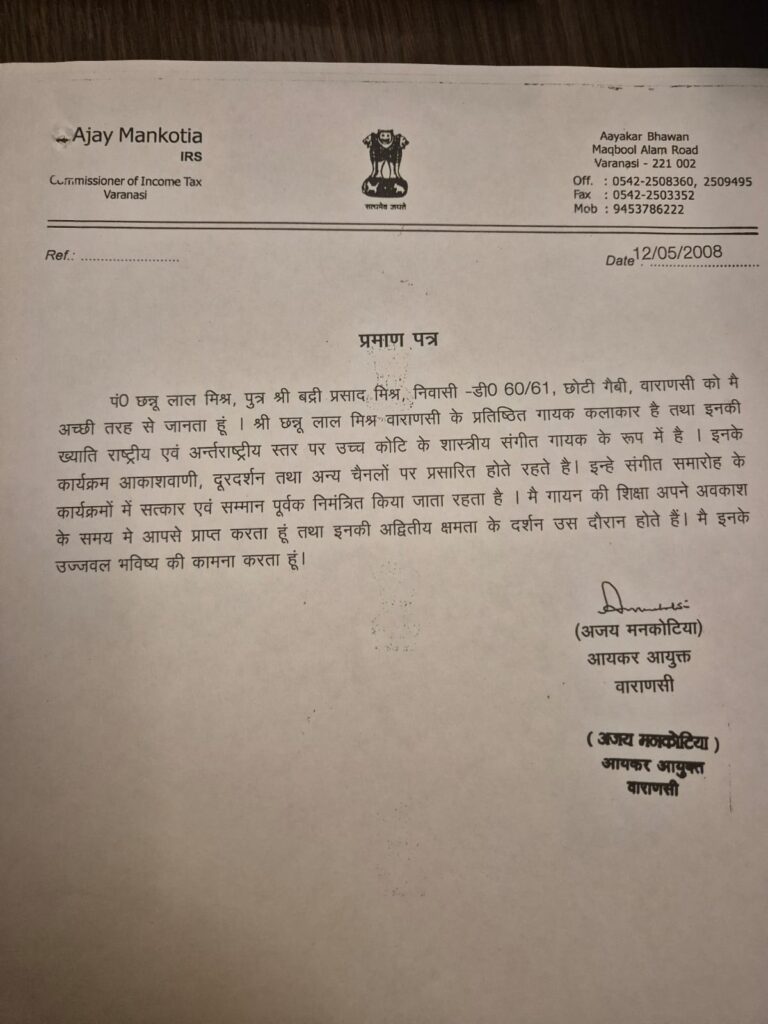
But even in 2007, his formidable talent was known to Banaras and indeed the State of Uttar Pradesh. That’s why I was very embarrassed when he asked me to give him a testimonial on my official letter-head. For good measure, he even provided me a template of a testimonial provided by another government officer. He brushed aside my protestations that he didn’t require any endorsement, given his standing in the world of music, and least of all from me – a person whose position was at the feet of the guru. So, with much discomfiture, I gave him one- a pygmy to a titan.
That’s what Pandit Chhannulal Mishra was – a titan.
He was a master of Hindustani classical and semi-classical music, celebrated for his expansive range, emotional depth, flame keeper of the Banaras gharana (semi-classical) and Kirana gharana (khayal) who mesmerised his listeners for seven decades.Possessed of a distinctive gravelly voice, honed to a molten mellowness, he moved effortlessly across three octaves with smooth, lightning-fast taans with no vocal strain, no state of contortion nor any theatrics nor hesitation nor artifice. He was widely considered a premier exponent of the thumri, dadra, kajri, and chaiti styles, infusing light classical forms with profound spiritual and folk resonance – blending Punjab, Purab and Gaya traditions into a soulful style.
He possessed a rare command over regional folk traditions, incorporating up to 70 types of folk melodies into a classical framework. He took singing of bhajans to another level. He viewed performance as a prayer rather than mere entertainment, frequently setting verses from the Shri Ramcharitmanas to classical formats. Critics and purists praised his ability to keep the endangered nuances of Banaras semi-classical traditions alive. His popularity as a bhajan singer often overshadowed his strong classical training. He also sang a wide range of folk songs and did not have the usual disdain that classical musicians have for non-classical forms. For him, music was always a medium of communication, and no genre was ever inadequate for that purpose. With his ability to weave mythological tales into his singing, he kept classical music rooted in tradition while reaching ordinary listener
It was perhaps fitting that he breathed his last on Dussehra last year— a symbolic meaning for the singer who’s most enduring legacy was his recordings dedicated to Lord Ram -whether it was the four-volume rendition of the Sundarkand, the evocative Ram Vivaha, or his popularity as a kathaakar. His album Ram Ragahad him singing only the words ‘Raja Ram’ for more than one hour in a deeply moving tribute to devotion. He was a scholar-performer who could render the Ramayana as though it were unfolding in real time. When he sang the Sunderkand or the Hanuman Chalisa, temples turned into kathas—Ram’s exile, Sita’s longing, Hanuman’s devotion—all brought alive in the moment.
He was born on August 3, 1936, in the musically rich village of Hariharpur in Azamgarh — often described as a place inhabited only by musicians. His real name was Mohan Lal Mishra but his mother named him Chhannu because, as per the interview given by the singer, in the villages it was believed that babies remained alive when they were given a ‘bad name’. He was initiated into music by his father, the late Pandit Badri Prasad Mishra at an early age. His marriage to Manorama, daughter of the Benaras gharana tabla maestro Pandit Anokhelal Mishra, cemented his position in the vibrant classical music world of Banaras. He also trained under Kirana gharana vocalist Ustad Abdul Ghani Khan — a lesser-known performer but an erudite master. This cross-gharana training contributed to the depth that marked his music. He was profoundly influenced by musicologist and scholar Thakur Jaidev Singh. It was perhaps this influence that deepened his understanding of the intrinsic link between music and devotion. For him, bhakti was not merely a theme; it was the very essence of his music.
His iconic recordings with the Devi Foundation brought him to a wider stage in the early 2000s, when he was already over 60. The first album, Anjali (2001), was a resounding success — released in Mumbai by Amitabh Bachchan. The Foundation had other notable releases too with him – Sundarkand, Shiv Vivah from Shri Ramcharitmanas, Kabir, Krishna Madhav, Holi Ke Rang – Tesu Ke Phool, Ram Rang and Ram Raga. He became a fixture at virtually every major music festival in the country. Yet he remained equally committed to singing at intimate baithaks. He even lent his voice to a few films – Aarakshan (2011) – ‘Saans Albeli’ and ‘Kaun Si Dor’ (with Shreya Ghoshal) – Music by Shankar-Ehsaan – Loy, Lyrics – Prasoon Joshi; and Let’s Talk (2002) – traditional compositions like ‘Tore Naina ‘and ‘Sajan Tum Kahe Ko Neh Lagaye’, Music – Ram Sampath.
His affability on stage, his instinctive connect with audiences and humour made him a much-loved performer. He engaged with all types of listeners — connoisseurs as well as the uninitiated — with equal ease and warmth. He drew audiences wherever he sang. He wasn’t just a musician; he was one of the greatest scholars of the Ramayana. Whenever he sang, his music left people stunned. And when he explained with rare clarity, audiences realised they weren’t just listening to music but experiencing history, devotion, and wisdom. He was a people’s artist.
He had a masterful command over various music style. His thumris bore the earthy Purab Ang of eastern Uttar Pradesh, his khayals the contemplative depth of Kirana, and his bhajans the devotion of Tulsidas. He melded folk and ragas, culture and devotion, and sang the joy of Holi, the yearning for saawan and timeless tales from the Ramayana. He had the gift of turning his performances into a conversation with the divine. His deeply moving renditions include ‘Saawan Jhar Laageela Dheere Dheere’, a soulful kajri steeped in monsoon longing, ‘Kaise Sajan Ghar Jaibe’, a heart-wrenching thumri exploring themes of separation and devotion, and his powerful Sohar renditions — traditional folk songs that celebrate the joy of childbirth. One of his most popular is the evocative ‘Barsan Laagi Badariya’ with Girija Devi. His vast repertoire included rare horis — some dedicated to Shiva, such as ‘Khelen Masaane Mein Holi, Digambar’.
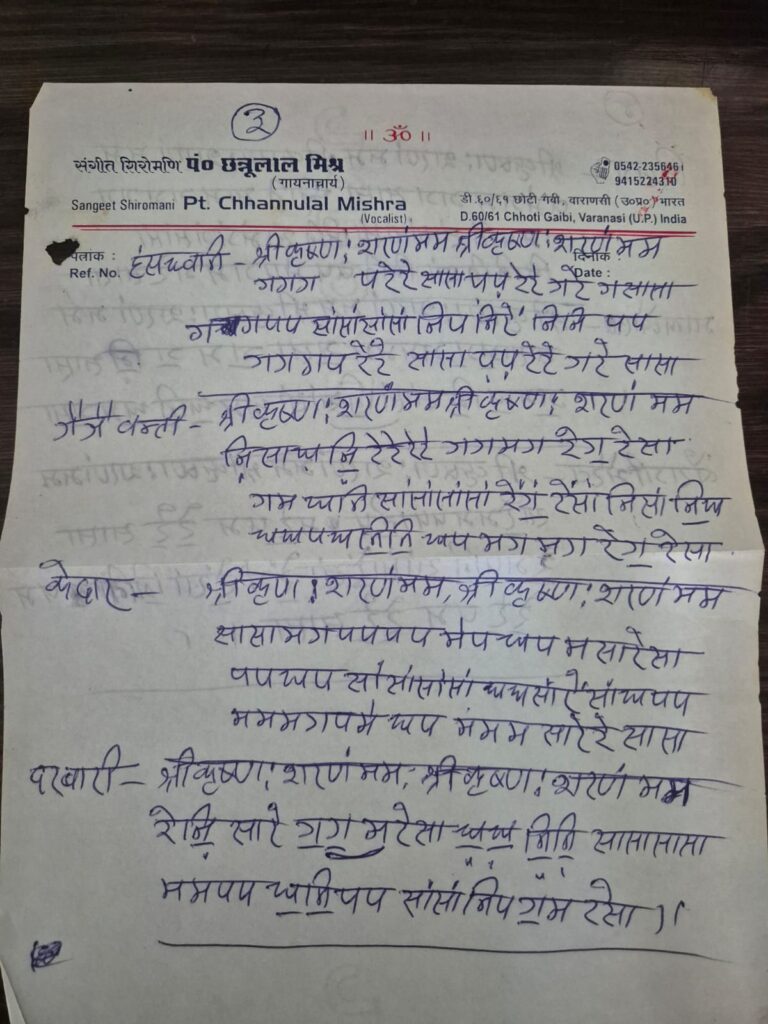
He remained a dedicated teacher throughout his life. He even taught Pandit Veerbhadra Mishra, mahant of the Sankat Mochan Temple in Banaras. During my music sessions with him he would voice his unease over the waning interest of younger generations in classical traditions. He was strained to note that nobody was coming to learn. He would say that they had become masters in their heads. They thought that just because they could sing a taan better than their guru, there was no need to learn. He lamented that they didn’t understand that learning an art required seriousness, it required patience. It was a trend he believed was threatening the survival of a tradition that has represented India’s rich cultural heritage for centuries. I was very touched when he recorded a tape of a bhajan stanza in multiple raags for me, to demonstrate the difference and the majesty of each raag composed over a common lyric. He even penned it down for me.
I would meet him outside the music room too. He was deeply intertwined with the Gulab Bari musical tradition of Banaras. Gulab Bari (“Garden of Roses”) is a 18th-century semi-classical music festival that dates back to the Nawabs of Awadh. Celebrated in Banaras immediately following Holi, it welcomes the Hindu calendar month of Chaitra. Performers focus on chaiti—a genre defined by its slow tempos, deep romanticism, and themes of love and longing—as well as complementary dadra, hori, and thumri compositions. I heard him ina Gulab Bari event, his booming, sonorous voice bringing unparalleled emotional depth and spiritual authority to the folk and classical melodies. His flawless shifting between Mirzapuri and Banarasi variants of kajri and chaiti truly made him the spiritual anchor of Varanasi’s spring music festivals.
He passed away on October 2 last year. On his death, Prime Minister Modi, who had the singer as one of his proposers in the 2014 elections from Banaras, heap encomia on him.
For Banaras, Pandit Chhannulal Mishra was not just an artist but its soul, giving voice to its traditions, its rivers, and its faith. For the country, he was not only a master musician but also a devout spiritualist – a rare blend of musical brilliance and devotion.