
How does one describe Bhupinder’s voice? Was it the voice of a wounded heart; did the heavy bass in his throat represent the weariness of the soul; did his nasal tone echo mystical romanticism; were his velvety renditions a balm for parched souls? It was all of the above, and then some. Left to me, I would describe it as my ideal companion on a cold winter day, next to a fireplace, hot cognac in one hand, cigar in the other.
But who can put it better than Gulzar who had a close friendship and long professional association with Bhupinder. In the book Jiya Jale: The Stories of Songs (2018), Gulzar, in conversation with Nasreen Munni Kabir, believed that Bhupinder could sing ghazals beautifully because of his “Sufiana spirit” and his choice of poetry that was “of a higher level”. To emphasize what Singh’s voice meant to him, Gulzar said: “Tum apni aawaaz ka taaveez bana ke de do, main pehen leta hoon”.
But this God given gift also made his voice stand apart. It made it atypical. It made it non-commercial. And that had its own consequences.
Hindi mainstream cinema only accepts a commercial voice. Niche voices are also welcomed, albeit in a limited manner.
Commercial voices are generally characterized by a bright, clear, and often high-pitched tone. Bollywood music has often favoured such an aesthetic. This established preference creates a subconscious association for listeners between this vocal style and successful Bollywood music.
Such voice is designed to be easily accessible and catchy, making the music more appealing to a broader audience. It is seen as more easily fitting with the visual aesthetics and expressions of the actors. Most Bollywood songs are designed to be melodically simple and easily remembered, which can be easier to achieve with a more mainstream vocal style.
That is the reason why non-conformist voices remain on the fringes of Hindi film music. While the mainstream singers will power ahead and collect songs in their thousands in their repertoire, the other voices will be lucky if they achieve a few hundred songs, though the percentage of their hits will probably be higher.
Bhupinder was one such. His distinctive voice was way too divergent for the expectations built up from Hindi film playback singing; his voice too dense and heavy to suit a Hindi film hero; his scorching melancholia not lending itself as playback for the bump and grind routine on the screen.
So, he stayed in the suburbs of Hindi film music, his deep resonant texture, his unique timber creating priceless songs, each a gem. Perhaps a good thing. Being mainstream would have robbed his songs of their sheen, made many of them ordinary – normal when quantity takes over. Too much of a good thing can be counter-productive.
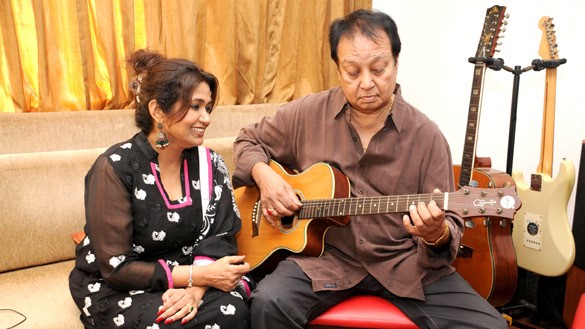
Photo: Bhupinder & Mitali Singh rehearses for their upcoming music album Aksar. This file is licensed under the Creative Commons Attribution 3.0 Unported license. Attribution: Bollywood Hungama
Bhupinder also had guitar-playing, private ghazal albums, concerts and mentoring as part of his CV. Bhupinder Singh Soin, born 6 February 1940, in Amritsar, had a wide canvas to his talent.
Bhupinder, the singer, may never have come about. That it happened is attributable to his father, vocalist and music teacher Natha Singh, who trained him. Since Natha Singh was very strict, little Bhupinder hated music and wasn’t keen on learning it. However, as time passed, he fell in love with music and started learning it religiously.
Bhupinder, the playback singer, may have never come about but for serendipitous circumstances involving my late uncle Satish Bhatia, who worked in All India Radio, Delhi (he retired as Chief Producer – Light Music). Bhupinder started his career as a casual artist for AIR under my uncle as singer and guitarist. My uncle was a friend of Madan Mohan. On one of his trips to Delhi, Madan Mohan came to my uncle’s house for dinner. My uncle invited Bhupinder too. On being told who he was , Madan Mohan asked Bhupinder to sing. The singing so impressed Madan Mohan that he invited him to Bombay and gave him the opportunity to sing the song ‘Hoke Majboor Mujhe Usne Bulaya Hoga’ alongside Rafi, Talat, and Manna Dey in Chetan Anand’s Haqeeqat (1964). (In any case, just as a mountain brook finds its way to the sea, Bhupinder’s talent would have certainly earned him a ticket to Bombay some day).
What a baptism it was!
Bhupinder held his own against the stalwarts and sang the first antara no less competently as the others. What’s more – he even appeared in the song and sang his antara, though bizarrely Rafi lip synced Bhupinder’s opening line of the song.
Thus began his innings in Bombay – very modest initially.
Bhupinder again appeared on screen to sing his first solo ‘Rut Jawaan Jawaan’, in Aakhri Khat (1966). This unique and stylish composition of Khayyam’s blended Western and Indian musical elements. Besides singing, Bhupinder played the guitar as well with the trumpet of Chic Chocolate adding to its charm. The song had sensuous and elegant feel. The song was in crooner style with music interspersed with dialogues. Bhupinder’s brooding and unusual voice made the song truly memorable, and ordinarily should have been his take -off moment. But that would come later.
In Jewel Thief (1967), he sang only ‘O Shalu’ in the SD Burman composed ‘Hothon Mein Aisi Baat’, Lata being the singer. Many years later, both would sing memorable duets – each playing an equal role. SD Burman made amends two years later in Prem Pujari (1969) when Bhupinder sang a duet with Kishore Kumar – ‘Yaaron Nilaam Karo Susti’. The same year saw Bhupinder sing a duet with Rafi in Jeene Ki Raah (1969) – ‘Aane Se Uske Aaye Bahaar’, though this version is not widely known; Rafi’s version got traction.
I remember an amusing incident with Bhupinder in my uncle’s house in the late 60s. I was 12 years old. Bhupinder asked me whether I knew who he was and the songs he had sung. He disclosed the number of the handful of songs he had sung till then. I mentioned the list to him. He was impressed but taken aback when I told him he had missed out one song. He re-counted and said no, his catalogue was correct. I then mentioned the Jewel Thief song. He got up and embraced me.
Since Bhupinder wasn’t deluged with offers, and neither did he seek them, he decided to use his other skill set – the guitar. It was his exceptional skills with the instrument that landed him a job with the man who would give him some of his most celebrated work: RD Burman. ” In the early sixties both of us had very little work. So, we would just hang out together,” he reminisced. It was this strong bond of friendship that was later to transform into a working relationship that resulted in some of the most popular songs of Bollywood.
He would go on to be one of R.D. Burman’s closest friends and become a permanent member of his team till the early 1980s. In Abhilasha (1969), he sang a duet with Manna Dey and Maruti Rao in RD Burman’s ‘Yaaron Hamara Kya’, and also played the guitar in ‘Wadiyaan Mera Daaman’ from the same film.
In 1968, Bhupinder also released his first private album which had three self-composed songs. He would release several private ghazal albums in his career. Introducing bass, drums and guitar to ghazals helped him bring a touch of Western, modern instrumentation to the tradition of ghazal gayaki.
If the 60s saw a muted beginning, things changed dramatically in the 70s.
RD Burman got Bhupinder to lend uncredited vocals for the title track of OP Ralhan’s film Hulchul (1971). Hare Rama Hare Krishna (1971), directed by Dev Anand, released in the same year, and the song ‘Dum Maro Dum’ attained cult status. Bhupinder was lauded for his exceptional work on the guitar. He played guitar in many other iconic songs, including ‘Chingari Koi Bhadke’ in Amar Prem (1972), ‘Chura Liya Hai’ in Yaadon Ki Baaraat (1973), ‘Mehbooba O Mehbooba’ in Sholay (1975), and many others.
Bhupinder played the guitar for other composers as well. According to veteran music director Naushad, when it came to the guitar, no one could match Bhupinder. He considered Ambar Ki Ek Paak Surahi composed byUstad Vilayat Khan from Kadambari (1975) as one of his best creations. Another of Bhupinder’s great guitar renditions was in ‘Tum Jo Mil Gaye Ho’ from Hanste Zakhm (1973) with music by Madan Mohan.
Bhupinder also paired up with Madan Mohan, Jaidev and Khayyam and sang memorable songs.
Bhupinder’s work with Gulzar as the lyricist and R.D. Burman as the music director stood out. There was a spiritual quotient in his voice which remains sharply etched in the soul of the listener to this day. He nuanced his vocalizing in their films.
Bhupinder’s first song with Gulzar/RD Burman was ‘Beeti Na Bitai Raina’ for the film Parichay (1972). This song was RD Burman’s first classical duet composition based on Raag Yaman Kalyan. Bhupinder’s deep voice and his singing with poise, confidence and understated finesse was refreshingly different and blended well with (actor) Sanjeev Kumar’s expression of resignation. Lata and Bhupinder came together for ‘Naam Gum Jaayega, Chehraa Yeh Badal Jaayega’ for the film Kinara (1977) – the song known for its abiding aura.
Regarding the song ‘Dil Dhoondta Hai Phir Wahi Fursat Ke Raat Din’ from Gulzar’s Mausam (1976), Gulzar mentioned a trait of Bhupinder’s. He said, “I had mentioned Bhupi’s name to Madan-ji. And he was close to Madan-ji too…Bhupi is a bit of a fakir. Woh ek sai aadmi hai, just like the Sufis and sadhus. They look lazy but they are very focused and attentive. There is a bit of ruhaniyat in him. If something interested him, he would take it up. There is no greed or haste in him. Whatever he does, he does from his heart.”
Gulzar wrote the lyrics for Bhupinder’s third LP- Woh Jo Shaayar Tha (1980).
Bhupinder had another close friend – singer Jagjit Singh. Sathya Saran threw light on their bond in the book Baat Niklegi Toh Phir: The Life and Music of Jagjit Singh (2015). Saran wrote, “Jagjit and Bhupinder were both strugglers…They sometimes shared a room, then they would get shunted out. Life was not easy…When a few of his friends came to know that Jagjit was getting married (to Chitra Shome), they pitched in…Bhupinder pitched in with two flower garlands.”
Gulzar knew both these people intimately, so he was aware of what transpired in their personal lives. He told Kabir, “Sometimes when Jagjit and Chitra fought bitterly, Bhupi would sort out the problem between them, reminding them that his forty-five rupees (spent on the wedding) had better not go waste. Then their quarrel would turn into good humour.” Mitali Singh (Bhupinder’ wife – a Bangladeshi singer) was also part of this group, which was more like a family.
In Gulzar’s serial Mirza Ghalib (1988) aired on Doordarshan, Jagjit Singh had Bhupinder lend his voice to Bahadur Shah Zafar’s ghazal, ‘Ya Mujhe Afsar-e-Shahana Banaya Hota’, and Ghalib’s rival and courtly poet, Zauq’s ‘Lai Hayat Aaye Qaza Le Chali Chale’. Both ghazals exuded anguish of the highest degree.
The songs that Bhupinder sang dealt with the anxieties and sadness and dilemmas and existential issues. The songs served as a trusted companion in facing the vicissitudes of life. His voice was the best platform to highlight the quotidian struggles of the common man. He lent these daily plights the right gravitas and moodiness.
The need to pause in the rush of life, to stand and stare in this life full of care, in Madan Mohan’s ‘Dil Dhoondta Hai Phir Wahi’ (Mausam ,1975) was rendered with just the right languor and languidness. Only Bhupinder could have evoked melancholy and alienation the way he did in Jaidev’s ‘Ek Akela Is Sheher Mein’ (Gharonda, 1977), a song about a migrant’s search for a foothold in a megapolis.
There was the sense of anticipation amidst scepticism in Jaidev’s ‘Zindagi Mere Ghar Aana’ (Dooriyan,1979) and hope despite the unpredictability and frailties of life in Jaidev’s ‘Zindagi Cigarette Ka Dhuan’ (Faslah, 1974). There was the philosophical acceptance of shortcomings in life in Khayyam’s ‘Kabhi Kisi Ko Muqammal Jahan Nahin Milta’ (Ahista Ahista ,1981). The pangs of remembrance ran deep in Khayyam’s ‘Karoge Yaad Toh Har Baat Yaad Aayegi’ (Bazaar, 1982). He appealingly underscored austerity in the duet with Lata in RD Burman’s ‘Thodi Si Zameen, Thoda Aasman’ (Sitara, 1980).
Contrary to his popular image, Bappi Lahiri composed a number of ghazals, and the most popular of them might well have been Bhupinder’s ‘Kisi Nazar Ko Tera Intezaar Aaj Bhi Hai’ (Aitbaar, 1985), which was about lingering love and pining.
Not all his songs were serious. A playful repartee took place with Suresh Wadkar in ‘Huzoor Is Kadar Bhi Na Itra Ke Chaliye’ (Masoom, 1983). Bhupinder presented playful depth, as Suresh Wadkar rendered the lighter nuances. Similarly, he rendered the upbeat ‘Raat Banu Main Aur Chand Bano Tum’ in Mangalsutra (1981).
‘Ek Hi Khwaab’ (Kinara,1977) was a unique non -song that was a musical conversation, ebbing and flowing with Bhupinder humming and giggling while being contemplative. Bhupinder’s guitar work was the icing on this extraordinary cake.
As music became more commercialised in the 80s, Bhupinder, after getting married to Mitali, distanced himself from Hindi films and started singing ghazals. ” It’s a very decisive step and there’s no looking back. When you give a live show the response of the audience is instant and so is the gratification for an artist. It’s like making magic on-stage.”
This transition from film songs to classical based ghazals was indeed a giant step, a leap of faith. But even when he was singing film songs he never compromised with the basic Indian-ness of the songs. So perhaps, the transition wasn’t so fundamental.
For wife Mitali too, singing ghazals marked a big transition. She was already a well-known folk singer in her native Bangladesh when she made a trip to Mumbai and met Bhupinder.
She had come to do a concert in Mumbai and being a fan of Bhupinder requested him to join her on the stage. ” Little did I realize that he would soon be my companion for life,” said Mitali. ” I feel if Bhupinder had not come to films, he could have been a great classical singer. But he has no regrets. He’s had the best of both worlds.”
Bhupinder explained, “I didn’t leave Hindi film music because I wasn’t getting offers. The truth is that the kind of music they wanted me to do did not suit my style or my temperament. In the 80s, songs lost their relevance and just became one more part of a Hindi film. And for me, a song without the depth of lyrics is a song without soul. That’s why I have distanced myself from Hindi films.”
He further added, “If the music director insisted on unnecessary innovations, then I would simply refuse to sing. I insist on the purity of lyrics and examine the depth of poetry I lend my voice to.”
Bhupinder died on July 18, 2022.
On his death anniversary today, we pay tribute to the singer who firmly remained steeped in classicism, yet assiduously cultivated his popular appeal. His easy laid-back charm sat atop a volcano of talent. He lived life on his own terms; he sang songs of life on his own terms. He personified melody. His songs he sang will have a permanent shelf-life.
(Cover Photo: (sitting left to right) – Pankaj Udhas, Gulzar, Bhupinder Singh & Mitali Singh at Bhumitaal Music’s Dil Peer Hai album launch. Photo Credit: Anusha Srinivasan Iyer@Pinterest)
All India RadioartistsBhupinder SinghBollywoodBombayCinemaGuitaristHindi cinemaHindi filmsIndiaLegendary SingerMitali SinghMusicPunjabRD BurmanSingerSufi