
The death of Mahatma Gandhi came as a jolt to the film industry as well. As a mark of tribute, this song was conceived. It required the composing genius of a composing duo, the lyrical brilliance of Rajender Krishan and the soulful appeal of a young Rafi to make people rededicate themselves to Mahatma Gandhi’s ideals. Days leading up to and following Independence had seen horrific violence that killed millions and Mahatma Gandhi himself. The song underscored the futility of the madness which had convulsed the nation.
The lyrics recounted Mahatma Gandhi’s life from his education in London, his work in South Africa, to the independence and social movements in India. In the last verse, the music slowed dramatically and Rafi recounted Mahatma Gandhi’s last moment, “ahimsa ke seene par himsa ne goli barsayi”.
On Independence Day, 1948, Rafi was invited to sing this song at Pandit Nehru’s house. The song had such an effect on Pandit Nehru that tears rolled down his cheeks! The song reportedly sold a million copies in the first month of its release.
Generations of listeners of Radio Ceylon were drawn by Manohar Mahajan to his weekly programme Bhoole Bisre Geet with the signature song – “Abhi To Main Jawan Hun”by Lata Mangeshkar (and not Malika Pukhraj) from Afsana (1950). The traditional structure of a film song – mukhda and antaras, interspersed by instrumental interludes – was turned over its head. The song started with an antara which segued into the mukhda ‘Abhi to main jawan hun’. The inclusion of the song as the program mascot was a huge honour.
Husnlal- Bhagatram.
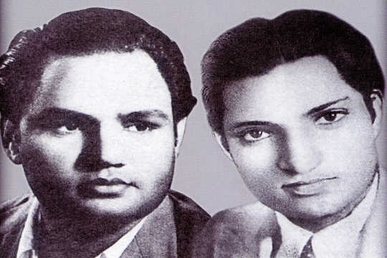
The legendary, pioneering music director duo in 1940s-50s Bollywood, consisting of brothers Husnlal (violinist/vocalist) and Bhagatram (harmonium) with immortal songs for Suraiya, Lata and Rafi. They occupy the most important place in the career of Suraiya along with Naushad, having composed most songs for her, several of which have become everlasting. They are among the few music directors who gave a major break to Rafi. Their professional and personal relationship with Lata Mangeshkar – especially Husnlal’s – is a part of the filmdom folklore. They are credited, along with Naushad and Anil Biswas, to have played the most important part in mentoring her.
They were the bridge between the old and the new; the door between the Pre- Independence and Post-Independence eras; the span between the vintage and the golden era; between the theatre-style singing of Zohra Ambalewali, Zeenat Begum and Amirbai Karnataki, and the smooth, mellifluous singing of Suraiya and Lata Mangeshkar; and between GM Durrani and Rafi. They were known for weaving Punjabi folk melodies and rhythms into their compositions, making music instantly catchy and popular.
Despite peak popularity in the late 40s/early 50s, their careers declined, they faced financial hardship, and died young.
Twenty years after the Gandhi song, on 28th December, 1968, Husnlal would die during his morning walk due to cardiac arrest, near Gole Market, New Delhi not far from Valmiki Colony where Mahatma Gandhi lived and taught from 1946-47. Willingdon Hospital (presently RML) would declare him “an unknown body”.
The fate of his elder brother Bhagatram was no better. He too died unheralded in 1973.
Husnlal and Bhagatram were the first to introduce the trend of music composer duos in the Hindi film industry.
The brothers Bhagatram (1914-1973) and Husnlal (1920-1968) were born in Kahma village in Jalandhar district in Punjab. They were initiated into music by their father Devi Chand. They later learnt music from their elder brother Pt. Amarnath. Husnlal had a passion for violin, and was also a good vocalist; he got further raining from Ustad Bashir Khan of Patiala. He also learnt music from the doyen of classical music, Pt. Dilip Chand Vedi. Bhagatram was an ace harmonium player.
Pandit Amarnath was a musician of eminence but died young. He is still remembered for the music of film Mirza Sahiban (1947), in which he was assisted by Husnlal and Bhagatram, starring Noorjehan and Trilok Kapoor. The film had outstanding songs by Noorjehan – “Kya Yehi Tera Pyar Tha”, “Aaja Tujhe Afsana Judai Ka Sunayen”, “Haath Seeney Pe Jo Rakh Do, To Qaraar Aa Jaye” and “Tum Aankhon Se Door Ho” (both songs with G.M. Durrani). Pandit Amarnath is also credited with training child prodigy Master Madan.
Bhagatram initially worked solo in some films in 1939 and 1940, using his full name Bhagatram Batish. These films and, with them, their music went unnoticed. It is only when the brothers formed the duo Husnlal-Bhagatram that they hit gold with their debut movie Chaand(1944) starring Begum Para and Prem Adib. Its song “Do Dilon Ko Ye Duniya, Milne Nahin Deti” (sung by Manju) became an instant success. The other singers were GM Durrani, Zeenat Begum and Sitara Devi.
In Hum Ek Hain(1946), which was Dev Anand’s debut film, they had an entirely different set of singers, namely Manik Verma, Zohrabai Ambalewali and Amirbai Karnataki. They repeated Zohrabai and Amirbai in Nargis(1946). But next year, they used Paro Devi as the lead singer in Heera. In the same year, they combined with their elder brother and mentor, Pt Amarnath (as noted above), in Mirza Sahiban(1947), composing some of the career best songs of Noorjehan. Thereafter, they took to Suraiya, Lata Mangeshkar and Rafi in a big way, dispensing with the vintage era singers. They did use other playback singers occasionally, often creating memorable songs.
Pyar Ki Jeet (1948) starred Suraiya and Rehman. It too became a musical super-hit. Some of the songs of Suraiya, “Tere Nainon Ne Chori Kiya”, “O Door Jaane Waley” and “Koi Duniya Mein Hamaari Tarah” became hot favourites. Then there was the all-time popular song of Mohammad Rafi in this film, “Ik Dil Key Tukre Hazaar Hue”. Also, there were some fascinating duets sung by Suraiya, Surinder Kaur, Meena Kapoor and Ram Kamlani.
“Chup Chup Kharey Ho Zaroor Koi Baat Hai, Pehli Mulaqaat Hai Ji Pehli Mulaqaat Hai” sung by Lata Mangeshkar and Premlata for the film Bari Behen in the year 1949 was one of the most popular melodies of its time. The other numbers also made an impact such as “Chaley Jaana Nahin” and “Jo Dil Mein Khushi Ban Kar Aaye”. The Punjabi style dholak played by Shankar (of the Shankar- Jaikishan duo) was a notable feature (Shankar left after the success of the film to team up with Jaikishan for Raj Kapoor’s Barsaat). Khayyam also trained under them.
One of the finest duets in Hindi films was composed by the duo- “Sun Mere Saajna, Dekhoji Mujhko Bhool Na Jaana”, based on raga Pahari and sung by Latar and Rafi for Aansoo (1952). Due to the length of the song, it was recorded on both sides of the 78-rpm record. The haunting melody, with a beautiful flute piece running all through, transported the listener to the innocence of the young lovers in the hills The duo also composed for B.R. Chopra’s maiden film Afsana (1950).
Husnlal’s command over the violin can be seen in different compositions. In giving shape to Lata’s tonal chord for a song, Husnlal would play the tune on the instrument. Lata was very close to Husnlal before C Ramchandra came into her life. Though the duo’s 100 odd songs for her are outnumbered by many music directors, they contain some of the sweetest songs she sang for anyone.
Their decline was very sharp. Shankar-Jaikishan became a duo to reckon with (Shankar doffed his hat to his mentors in Barsaat by using the interlude from the famous Suraiya song” Tere Naino Ne Chori Kiya “as a prelude and interlude in their song” Jiya Beqarar Hai”). Naushad with AR Kardar and Mehboob Khan, C Ramchandra with Filmistan, and SD Burman with Navketan divided up up the big banners amongst them. The one distinctive feature of Husnlai-Bhagatram’s music – Punjabiyat – could not withstand OP Nayyar whose music yelled Punjab from a long distance. Shama Parwana(1954) and Adl-e-Jehangir (1955) were their last noteworthy films. They continued giving music to some nondescript films, their last film being Sher Afghan(1966).
Frustrated with the situation, Husnlal bid adieu to the film world and set himself up at Chuna Mandi in Delhi’s Paharganj area where he started teaching classical music and giving concerts.
Bhagatram stayed on in Mumbai, but for survival he had to work as a musician in the orchestra of other music directors.
One other reason for their decline can be attributed to the limitation of their musical style. Several of their songs had a similar stock melody and instrumentation which became their signature style. This repetitiveness was one reason for their undoing.
My mother, then Usha Bhatia, and her brother Satish Bhatia, worked in All India Radio, Delhi where music director Roshan also worked. Just before Roshan left for Bombay to pursue his musical dreams with his second wife Ira Moitra (who was his disciple and also worked as singer with AIR), he stayed briefly at the house of Husnlal’s at Daryaganj, Delhi. My mother and her brother met Roshan there to bid him goodbye. At Bombay, Roshan stayed in a garage of Husnalal. It was in this garage, where his first son Rakesh was born.
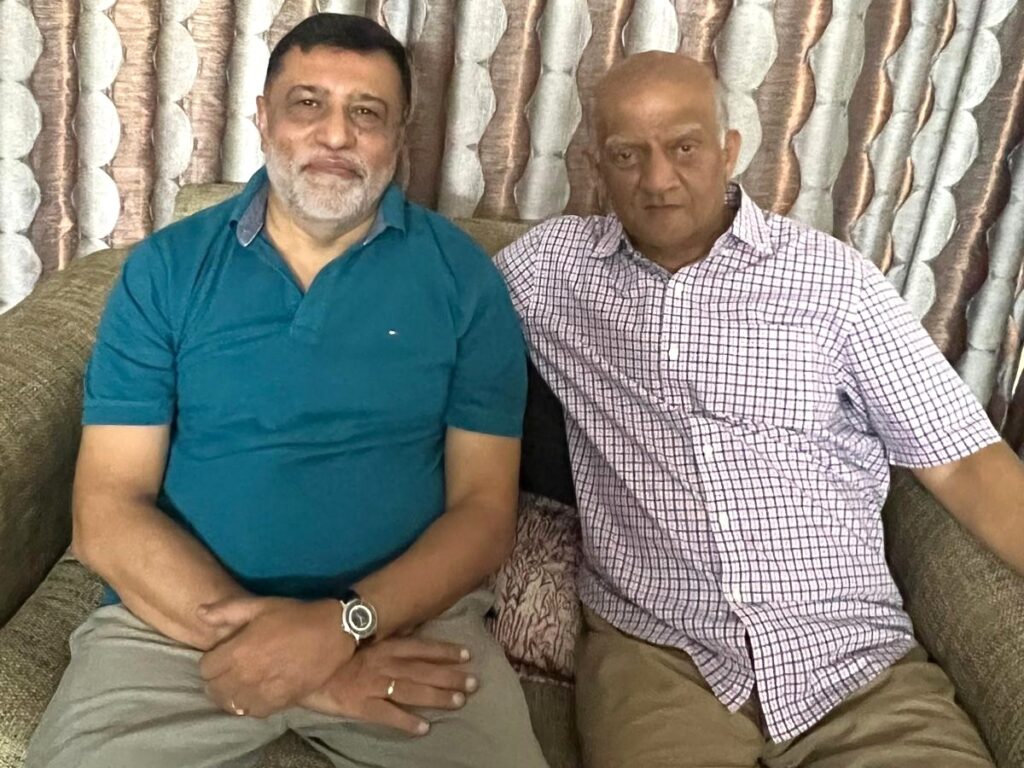
I have the good fortune of knowing Husnlal’s son Dinesh Prabhakar. He was a director, composer and violinist with AIR and Films Division with over 40 years of experience. He is currently settled in New York promoting Indian music. His forte is devotional music. We meet up when he visits Delhi.
Today is Husnlal’s death anniversary. He and his brother may have had a short stint in the film industry but their legacy is impressive and timeless.
(Husnlal- Bhagatram. Cover Photo Credit: https://en.wikipedia.org/wiki/Husnlal_Bhagatram)
BollywoodGandhiHindi filmsHusnlal BhagatramHusnlal- BhagatramIndiaJawaharlal NehruLegendary SingerMahatma GandhiMohammed RafiMusicPandit NehruSuno Suno Ae Duniya Waalon Bapu Ki Ye Amar Kahani