
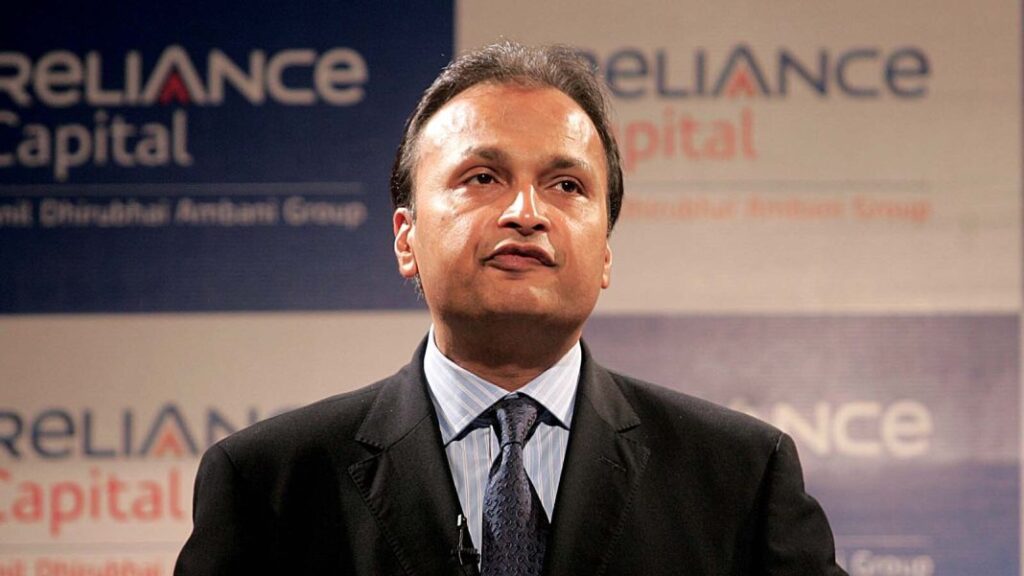
No one really expected that the Anil Ambani-backed Reliance Group, or ADAG, would be hauled up on charges of money laundering and defrauding banks such as State Bank of India and Yes Bank. While the conduct of the industrialist does not surprise those familiar with how business is done in India, what is intriguing is that a pro-business government would choose to act against him. After all, he is not the only one.
In 2025–26, banks in India were poorer by some ₹48,000 crore. This does not include the gargantuan losses worth ₹15 lakh crore incurred by the Indian financial sector because of a company called Rajesh Exports. What this means is that businessmen are not usually hauled up simply for doing business. They come to grief, as Ambani has, only when they dabble in politics.
These are still the early days of the Rajesh Exports scam, so more dirt may emerge regarding how government financial institutions such as the Life Insurance Corporation of India (LIC) acquired a large stake in this gold refining and trading company. The main question is: at whose behest did LIC acquire a stake in the company when it was already bleeding financially? Ever since this mother of all scams broke out, the names of those who allegedly persuaded LIC to buy the stake have been discussed in hushed tones. Some have even mentioned the Prime Minister and the Home Minister as the two figures who may have asked LIC to overlook Rajesh Exports’ limitations.
Paranjoy Guha Thakurta, an economist and journalist known for his work on the Adani Group and banking scandals, draws parallels with how the Prime Minister’s favoured business group has been funded by nationalised banks. A quick Google search will show that the Adani Group has bank loans amounting to approximately ₹2.6 lakh crore, much of it from SBI. Critics argue that its high debt levels stem from the overvaluation of its assets and companies, enabling it to secure larger loans than many public-sector companies could obtain.
Examples cited include Indraprastha Gas Limited (IGL), whose valuation was reportedly far lower than that of an Adani company involved in gas-based power generation. Other companies, too, were allegedly assessed in a similar manner by compliant public-sector banks whose managers appeared more than willing to extend loans to politically favoured business houses.
The phenomenal rise of many crony capitalists over the last decade has been attributed to the largesse they received through the transfer of loan-starved and weakened public-sector companies, often at throwaway prices. It was a case of giving a dog a bad name and then hanging it. Few tears were shed for these enterprises, but the beneficiaries grew larger and more powerful.
Some Indian conglomerates, including the Adani Group, were at one point compared with global giants such as Google, Apple, and even Elon Musk’s ventures, as their market valuations soared. It was around this time that the US-based Hindenburg Research investigated the Adani Group’s meteoric rise. The question asked then—and still asked today—is whether Hindenburg’s probe was entirely independent or whether it was backed by one of Adani’s global or domestic competitors, including the Ambanis.
The investigation led to the erosion of approximately $150 billion in market value. Hindenburg alleged that this wealth was built on accounting manipulation and inflated valuations, characteristics that critics describe as examples of crony capitalism, a phenomenon extensively analysed by Marxist economist and geographer David Harvey.
As stated above, informed sources have dropped hints that the raids on Anil Ambani’s companies are the manifestation of a complex mix of business rivalry and alleged attempts to destabilise the present government. This may sound far-fetched, but there are many who firmly believe that regulatory pressure from SEBI on the Adani Group was influenced by rival business interests, including those associated with Ambani.
There are reports suggesting that certain detractors of the government concluded that a change in their fortunes was impossible unless Prime Minister Narendra Modi’s government was weakened or brought down. According to informed sources, this alleged plan involved splitting the constituents of the National Democratic Alliance (NDA) and reducing the government to a minority. There were also reports that this group sought the support of Vice President Jagdeep Dhankhar to facilitate such an effort.
Dhankhar, who has worked with and built relationships across the political spectrum, has been alleged by some to have been involved in efforts to challenge the BJP-led government with the backing of influential financial interests.
“Ambani is being investigated not for his wrongdoing but for daring to conspire against this government,” claimed a source close to the government.
Bizarrely, some rumours suggest that the government does not believe the two Ambani brothers are truly hostile to one another and instead sees them as working together on political matters that could affect their business interests. According to these claims, the government believes the brothers acted in concert in the alleged conspiracy.
These sources further claim that the government is making an example of the younger brother while simultaneously signalling its willingness to act against the elder one as well. The government, they say, believes it is not yet politically secure enough to confront two of the country’s most powerful business houses at the same time. There are fears that such a confrontation could destabilise the government itself.
There is also a view that the Ambanis enjoy close ties with influential circles in the United States and that retaliation could come in some form if they are targeted. Some fear—perhaps incorrectly—that any action against the Ambanis could also have repercussions for the Adani Group.
To neutralise such risks, Adani, who is widely perceived to enjoy close ties with Prime Minister Modi and his government, is said to have strengthened relations with the Trump administration by promising investments worth $20 billion. Many observers within diplomatic circles in New Delhi believe that Adani’s influence could increase significantly in both India and the United States.
Some also speculate that he could affect the future role of External Affairs Minister S. Jaishankar within the government. A reshuffle of the Union Cabinet is widely expected in the near future.
(Cover Image Credit: northeastlivetv.com)
ADAGAmbaniCBIIndiaIndraprastha Gas LimitedLICPoliticsReliance