
Nearly four decades after its release, John Abraham’s landmark Malayalam film Amma Ariyan (1986) received a standing ovation at the 2026 Cannes Film Festival, where it was selected as the only Indian film in the prestigious Cannes Classics section.
A pioneering figure of India’s parallel cinema movement and a protégé of the legendary Ritwik Ghatak, John Abraham directed only four feature films before his untimely death. Yet his influence on Indian cinema far exceeds the size of his filmography.
For Amma Ariyan, his final feature, John co-founded the Odessa Collective and crowdfunded the film through public contributions—an audacious and unprecedented experiment in Indian filmmaking. After its completion, the film was screened free of cost across thousands of villages and towns in Kerala, transforming cinema into a genuinely people’s movement.
Blending documentary realism with a non-linear narrative, Amma Ariyan follows a young man carrying news of a friend’s death across Kerala. What begins as a journey gradually unfolds into a profound meditation on grief, memory, political commitment, and resistance in the turbulent social landscape of the 1970s.
Long thought to be lost, the film’s original camera negative was eventually rescued and restored in 4K by the Film Heritage Foundation from two damaged 35mm prints. Its triumphant reception at Cannes has reaffirmed John Abraham’s place as one of the most radical, uncompromising, and visionary voices in Indian cinema.
John had been a regular visitor to our medical college hostel from 1981 onward, following a seminal event—the Janakeeya Vicharana (People’s Trial) of a corrupt doctor at Calicut Medical College. The trial was organized by activists of the Janakeeya Samskarika Vedi (People’s Cultural Forum), the cultural front of the Naxalite movement.
The event attracted nationwide attention and generated widespread debate. It was even praised by the then Chief Justice of India, Y. V. Chandrachud, who acknowledged its moral force despite its questionable legal standing. Editorials supporting the action appeared in several national newspapers.
At the time, I was a second-year MBBS student. A small but committed group of medical students in Calicut maintained varying degrees of involvement with these political and cultural movements. Some participated actively; others remained sympathetic observers.
A few years later, a statewide agitation erupted against the privatization of medical education in Kerala. This time, many of us became deeply involved—from organizing meetings and mobilizing students to participating in demonstrations on the ground.
John followed the movement closely. During one casual conversation amid the agitation, he suddenly announced:
“I have cast you in my film.”
I dismissed the remark as one of his characteristic jokes. John had a mischievous way of blurring the line between seriousness and playfulness. But this time he meant it.
Without any prior experience in theatre or acting, I found myself standing before a camera, essentially portraying my own life—a student activist speaking out against the privatization of medical education.
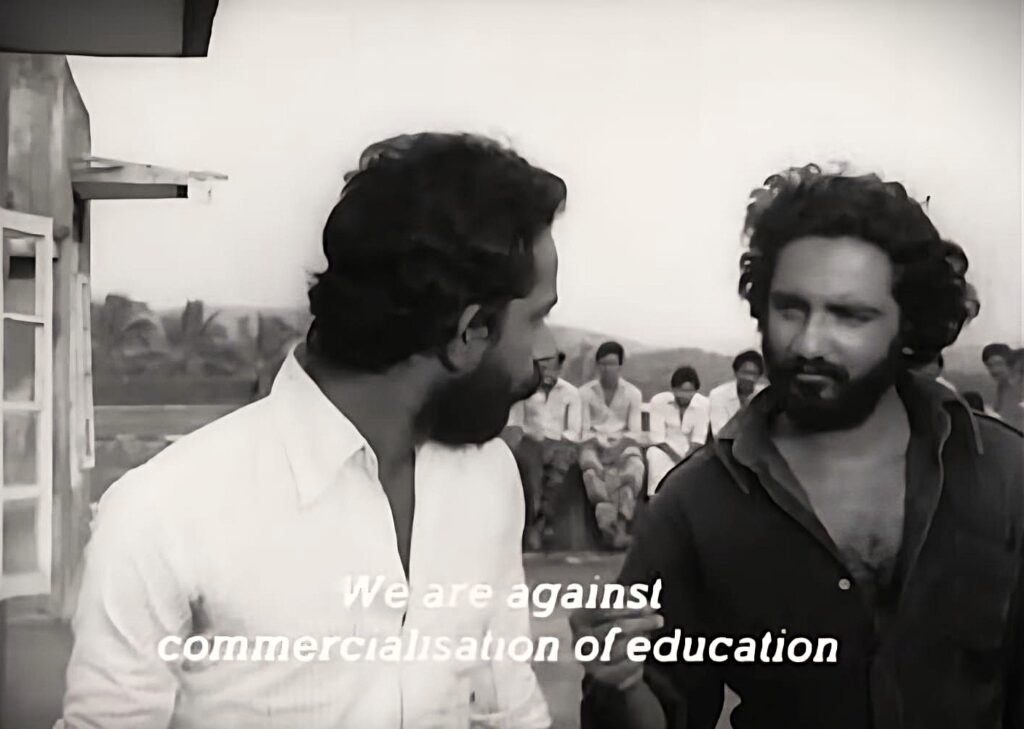
In the scene, I am addressing a gathering of students when the protagonist, played by Joy Mathew, arrives and pulls me away. Together, we visit a mutual friend’s house and then proceed to a hospital mortuary to identify the body of Hari, a young man who has died by suicide.
That brief appearance became my small place in the remarkable journey of Amma Ariyan.
Life moved on. After completing my MBBS, I earned a postgraduate diploma in Psychiatry from CMC Vellore and later completed my MD at NIMHANS, Bengaluru. For the past twenty-eight years, I have lived and practised in Australia.
Yet certain people refuse to remain in the past.
John Abraham is one of them.
His films, his laughter, his provocations, and his restless spirit continue to return—not as memories alone, but as recurring questions that refuse easy answers.
A poem grew out of those lingering encounters with John in memory.
John, Again, in Memories
Like a mirage
shimmering into being
across the blistering plains of summer
Like the raw frenzy spilling out
from a midnight barroom,
where the marathon of tavern madness
fizzles out into a lonely street
that swallows the last
drunk’s lonely footsteps—
like a fractured phoneme,
a splintered letter
that fits no cast
in the mold of rebellion—
like a Theyyam dancer
on the midnight streets of anarchy,
torches ablaze in both hands,
reeling in wild, woozy steps—
an apostle of visionary chaos—
like an inverted question
turned completely inside out,
grinning at sanitized solutions,
mocking them from behind their backs
with jocular disdain—
like the orphaned ache
of a bleak shadow
tangled in the live wires
of a pitch-black city,
hanging upside down—
like a stoic saint, unperturbed
by either path or destination—
like the eternal solace
living in the void
between the scream of a bohemian song
and perfect silence—
Upon the spiral staircase
of my own inner self—
the same stairs I keep
climbing up and down—
on every step stands
a restless shadow of John,
pointing a mad finger at me, saying:
“That’s me, but not me.”
— Dr. Rajan Iyyalol
2026 Cannes Film FestivalAmma AriyanAustraliacrowdfundedDocumentaryDr. Rajan IyyalolFilm Heritage FoundationIndiaIndian film in the prestigious Cannes Classics sectionIndian filmsJohn AbrahamMalayalam filmMBBSMedical StudentNaxalite movementOdessa CollectivePsychiatrysocial landscape of the 1970s